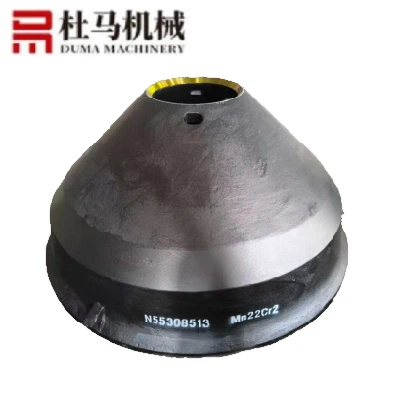
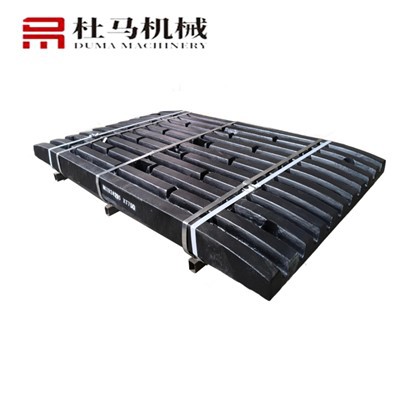
In the primary crushing circuit of high-capacity mining operations, the gyratory crusher serves as the central pillar of productivity. At the heart of this machine lies the Gyratory Crusher Upper Mantle, a component that demands extreme precision in both metallurgical composition and geometric design. As a direct-to-site manufacturer with a 42,000 m² production facility, we recognize that the mantle is not merely a wear part; it is the primary instrument of kinetic energy transfer used to achieve target particle size distribution (PSD) and maximum throughput.

The Physics of Size Reduction: Chamber Dynamics
The gyratory crusher functions through the interaction between the gyrating mantle and the stationary concave segments. The role of the upper mantle in particle size reduction is dictated by the "nip angle" and the variable volume of the crushing chamber.
- Initial Impact and Pre-Crushing: Large-run-of-mine ore first contacts the upper mantle. The mantle's surface profile is specifically engineered to "catch" and fracture large boulders upon the first stroke. By optimizing the tooth or rib profiles, we ensure the material is fractured effectively without excessive sliding, which is the primary cause of energy loss and attrition-induced fines.
- The Gradual Reduction Curve: As the material descends, the mantle's diameter increases, and the chamber volume decreases. This geometric evolution forces particles into multiple crushing cycles. The mantle's surface acts as an anvil, and the accuracy of its curvature determines the uniformity of the final product. A mantle cast with precise dimensional tolerances-maintained through our rigorous CNC machining protocols-ensures that the gap (CSS) remains consistent, preventing the bypass of oversized particles.
Metallurgical Integrity: Maintaining Profile Under Stress
In the high-pressure environment of primary crushing, mantle wear is inevitable, but how it wears is the difference between operational efficiency and frequent, costly downtime.
- Work-Hardening and Structural Stability: Our mantles are cast using advanced high-manganese steel formulations. Through a controlled "Water-Toughening" heat treatment process-performed in our microcomputer-controlled furnaces-we stabilize the austenite structure. This ensures that the mantle's surface hardens upon impact while the core retains the toughness required to prevent structural fatigue or catastrophic cracking.
- Internal Purity: Leveraging high-magnification metallographic testing, we ensure that every casting is free of brittle network carbides. For the operator, this translates to a mantle that maintains its profile for a significantly longer period, ensuring that the PSD remains stable throughout the life of the part.

Operational Strategy: Improving Throughput and Energy Efficiency
The objective of particle reduction is not just to break rock, but to do so with minimum power draw.
- Chamber Optimization: With over 4,000+ available patterns, we assist clients in selecting mantle profiles that match their specific ore hardness. A mantle that is too aggressive for soft rock may lead to "choke feeding" and excessive power consumption, while one that is too smooth for hard rock may result in low production volumes.
- Preventing "Over-Crushing": Proper mantle selection, in conjunction with our precise Gyratory Crusher Concave Segments, allows operators to dictate the final product curve. By fine-tuning the clearance settings and utilizing our OEM-standard components, plants can reduce the circulating load, which significantly lowers the energy cost per ton of finished product.
The Duma Commitment to Technical Traceability
Selecting a replacement mantle should be a decision rooted in data. As a factory-direct provider, we offer full batch-traceability for every component. This includes heat treatment logs, hardness certification, and dimensional inspection reports that provide the empirical evidence required for predictive maintenance planning.
For mining facility managers, the goal is to shift from reactive replacement to data-driven maintenance. By utilizing components that offer consistent metallurgical performance and a perfect dimensional fit, you eliminate the risks associated with on-site modifications and unplanned breakdowns. We invite you to contact our technical team to perform a chamber analysis and determine how upgrading your mantle metallurgy can drive higher efficiency and lower the total cost of ownership for your gyratory crushing circuit.