



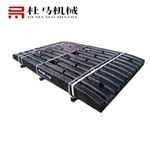


Concave And Bowl Liners
Why Choose Duma Machinery as Your Concave & Bowl Liner Supplier?
Duma Machinery manufactures cone crusher concave bowl liners in Mn13, Mn18, Mn22, and TIC-insert grades, covering replacement parts for Metso, Sandvik, Symons, Telsmith, and other major brands. With 4,000+ patterns on hand and full in-house casting, heat treatment, and machining, we supply mining operators, quarry contractors, and wholesale distributors with liners built to outlast standard OEM parts. All products are ISO 9001 certified and available in standard or custom profiles.


What Are Concave Bowl Liners?

Concave bowl liners are the primary wear components inside a cone crusher, forming the crushing cavity where feed material is compressed and broken down. The concave is the fixed outer liner bolted to the main frame, while the bowl liner sits on the crushing head and moves with it. Together, their profile geometry, material grade, and fit accuracy directly determine crushing efficiency, product shape consistency, and how long the crusher can run before a liner change.
Duma manufactures both components as matched sets, precision-cast to maintain the correct cavity geometry from first use through to end-of-wear.
Key Advantages of Duma's Concave Bowl Liners
Extended Wear Life Through Alloy Engineering
Standard manganese steel work-hardens upon impact, but performance varies by alloy. By using modified grades (Mn13Cr2, Mn18Cr2, Mn22) with controlled chromium, Duma inhibits carbide precipitation, ensuring a tougher microstructure and longer service life than standard Mn13.
01
Optimized Cavity Profile
Liners are engineered with profiles that distribute feed material evenly across the full crushing surface. Uniform loading reduces localized wear peaks, keeps the product curve stable throughout the liner's life, and protects the crusher frame from uneven stress.
02
Precision Dimensional Fit
Using a 4,000+ pattern library built specifically around major crusher brands, Duma liners are cast and machined to the original OEM dimensional tolerances. Parts are ready to install without field modification, reducing changeover time and the risk of loose-liner damage.
03
Full In-House Production and Traceability
Every liner passes through Duma's own casting, water-toughening heat treatment, machining, and inspection departments. Each production batch carries a complete technical file including material certificate, heat treatment curve, hardness test results, and dimensional inspection report — available on request.
04
Flexible Supply for Any Order Size
Standard replacement profiles for common models (Metso HP/GP series, Sandvik CH/CS series, Symons, Terex) are held in stock with a 7–10 day shipping window. Custom or non-standard castings are produced in 35–45 days. Trial orders are accepted with no minimum quantity requirement.
05
Concave Bowl Liner Specifications
| Parameter | Details |
|---|---|
| Material Grades | Mn13, Mn13Cr2, Mn18, Mn18Cr2, Mn22, TIC Insert |
| Compatible Brands | Metso HP/GP series, Sandvik CH/CS/CG series, Symons, Telsmith, Kleemann, Terex, Trio, Powerscreen |
| Profile Options | Coarse (C), Medium (M), Fine (F), Extra Fine (EF) |
| Initial Hardness | ~HB200 (work-hardens to HB500+ under operating impact) |
| Heat Treatment | Controlled solid solution treatment + water toughening (water quenching) |
| Quality Standard | ISO 9001:2015; ASTM A128 material grade reference |
| Lead Time — Stock Items | 7–10 days |
| Lead Time — Custom Orders | 35–45 days |
| MOQ | Flexible; trial orders accepted |
| OEM/ODM | Accepted — drawing-based, sample-based, or reverse engineering |
Types of Concave Bowl Liners
Concave and bowl liners are typically classified based on their profile design and the specific crusher model they serve.

By Profile Design
Profile selection controls the size of the crushing gap and the final product gradation. Coarse profiles are used for primary and coarse secondary crushing where large feed sizes must be reduced quickly. Medium and fine profiles suit secondary and tertiary stages where tighter product specifications apply. Extra-fine profiles are used for high-reduction-ratio applications demanding close particle size control.

By Material Grade
The right material depends on the balance of impact and abrasion in the application. High-impact primary crushing typically calls for Mn18 or Mn22 to maximize work-hardening response. Abrasion-dominated applications with lower impact benefit from modified grades such as Mn13Cr2 or Mn18Cr2, where the chromium addition improves resistance to sliding wear. For extremely abrasive ores — high-silica quartzite, hard granite, or copper ore — TIC (titanium carbide) insert liners embed hard carbide particles into the manganese matrix for significantly higher abrasion resistance.

By Crusher Brand Compatibility
Duma manufactures direct replacement liners for all major crusher platforms. The 4,000+ pattern library covers the most widely used models across Metso (HP200, HP300, HP400, HP500, GP100, GP200, GP300, GP500), Sandvik (CH420, CH430, CH440, CH660, CS420, CS430, CS440), Symons (2', 3', 4.25', 5.5', 7'), Terex, Kleemann, Telsmith, Trio, and Powerscreen. Models not in the existing library can be produced from customer drawings or by reverse engineering a worn sample.
Material Selection for Cone Crusher Concave Bowl Liners
High Manganese Steel (Mn13, Mn18, Mn22)
The standard choice for crushing applications involving significant impact loading. High-manganese steel derives its wear resistance from work-hardening: under repeated impact, the surface layer transforms from an initial hardness of around HB200 to HB500 or above in service. Higher manganese content (Mn18, Mn22) increases the work-hardening response and is recommended for primary and coarse secondary crushing of hard rock. All Duma high-manganese castings are processed to ASTM A128 grade references.
Modified High Manganese Steel (Mn13Cr2, Mn18Cr2)
Chromium additions to the alloy suppress the formation of brittle grain boundary carbides during solidification, producing a cleaner austenitic microstructure. The result is better toughness under repeated impact and improved wear resistance in sliding-dominated conditions compared to standard unmodified grades. Duma verifies the microstructure of every batch using metallographic inspection at high magnification, confirming the absence of network carbides before shipment.
TIC Insert Liners
For applications where standard manganese steel wears too quickly — typically high-silica ores, quartzite, or particularly abrasive aggregate feed — Duma offers liners with titanium carbide (TiC) inserts embedded into the manganese matrix. The TiC particles are substantially harder than the surrounding steel and resist the micro-cutting mechanism responsible for rapid abrasive wear. TIC liners are produced on a custom basis and are suited to tertiary and pebble-crushing stages where feed sizes are smaller and impact loads are lower.
Applications of Concave Bowl Liners

Hard Rock Mining

Aggregate and Quarry Production

Cement and Industrial Minerals

Recycling and Demolition
Components of the Concave Bowl Liner Assembly
Concave and Bowl Liner Castings
The two primary wear castings that form the crushing cavity. The concave is seated in the main frame; the bowl liner fits over the crushing head. Both are replaced as a matched pair to maintain correct cavity geometry.
Backing Compound
Specially formulated epoxy backing compounds fill the void between the liner and frame, ensuring uniform support. Proper application prevents liner movement and evenly distributes crushing loads, making it the most critical factor in preventing liner cracking and frame damage. Always use professional-grade compounds mixed to manufacturer specifications.
Locking Bolt and Nut Assembly
The mechanical fasteners that retain the concave against the frame and the bowl liner on the head. Torque to the specified value and check within the first 48 hours of operation — liner settling after installation is normal and fasteners require re-torquing before first full production shift.
Maintenance and Replacement Guideline
Feed Distribution and Choke Feeding
Cone crushers are designed to operate choke-fed, meaning the crushing chamber is kept full at all times. Choke feeding promotes particle-on-particle crushing, distributes wear evenly across the full liner profile, and protects the crusher from uneven loading. Segregated or directed feed causes localized wear on one side of the liner, dramatically reducing effective liner life.
Crusher Setting (CSS)
Always operate within the specified minimum closed-side setting for the installed liner profile and material. Running below minimum CSS transfers load to the frame rather than to the crushing action, causing accelerated liner breakage and potential frame damage.
When to Replace
Replace liners when wear has consumed approximately 70–80% of the original liner mass, or earlier if the crushing profile has degraded to the point where product specification can no longer be maintained. Waiting until complete wear-through risks liner breakage and frame scoring, which is far more costly to repair than a scheduled liner change.
Inversion Strategy for Bowl Liners
Where the bowl liner profile permits, rotating or inverting the liner at 50% wear to equalize the wear pattern can extend total service life by 15–25%. Consult Duma's technical team before inverting to confirm the profile is symmetrical and inversion is safe for the specific model.
Why Choose Duma Machinery as Your Concave Bowl Liner Supplier?
- ISO 9001:2015 Certified, Full In-House Production Duma's 42,000 m² facility covers casting, heat treatment, machining, and inspection under one roof — fully ISO 9001:2015 certified, with no outsourcing of critical processes.
- Verified Material Quality, Batch by Batch Every batch is hardness-tested, metallographically inspected, and dimensionally verified, with a complete technical file available on request.
- 4,000+ Patterns Covering All Major Brands Most orders go straight to production from our existing library — no new tooling cost or delay. Non-standard models are produced from drawings or a worn sample.
- Custom Alloy and Profile Capability Duma's technical team specifies alloy grades and cavity profiles tailored to your ore and operating conditions, with full ODM support from materials selection to production.
- Competitive Pricing Through Direct Factory Supply No trading company intermediaries — pricing reflects actual manufacturing cost, not distribution markup.
- 24/7 Technical Support and After-Sales Service Our team is available around the clock for pre-sales consultation, installation support, and in-service wear analysis, backed by a 12-month manufacturing defect warranty.

Our Services
OEM/ODM Customization
Full drawing-based and reverse-engineering production capability. Send us a CAD file, a worn sample, or the crusher model and we handle the rest.
Pre-Sales Technical Consultation
Material grade recommendation, profile selection guidance, and compatibility verification based on your crusher model, ore type, and operational parameters.
Global Logistics
Export documentation, full technical file package, and reliable international shipping to mining markets including Australia, South Africa, Chile, the US, Canada, and Europe. FOB, CIF, and EXW terms available.
Quality Warranty
12-month warranty against casting defects, backed by batch-level traceability through material, heat treatment, and inspection records.


Certifications


Frequently Asked Questions About Concave Bowl Liners
1. Q: How long do concave bowl liners typically last?
A: Liner life depends on feed material hardness, abrasiveness, crusher setting, throughput rate, and operating practice. In aggregate quarrying of medium-hard limestone, a set of Mn18 liners in a mid-size cone crusher might last 800–1,200 operating hours. In primary hard rock mining with highly abrasive ore, the same liners may need replacing in 300–500 hours. Duma's modified alloy grades are engineered to extend service life compared to standard unmodified manganese steel, and our technical team can advise on grade selection based on your specific conditions.
2. Q: What is the difference between a concave and a bowl liner — and how do they relate to the mantle?
A: The concave is the fixed outer liner secured to the main crusher frame. The bowl liner is the moving inner liner mounted on the crushing head. In some terminology, "mantle" refers specifically to the inner moving liner (what Duma classifies as the bowl liner), while "concave" always refers to the fixed outer liner. The terms vary by brand and region, so when ordering, it helps to specify fixed outer liner (concave) or moving inner liner (bowl liner/mantle) to avoid confusion.
3. Q: Can Duma supply liners for older or non-standard crusher models?
A: Yes. Duma's 4,000+ pattern library covers most production crusher models from major brands. For older or less common models not in the library, our engineering team can reverse-engineer the part from a worn sample or from customer-supplied drawings. Contact our technical team with the crusher brand, model number, and serial number and we will confirm availability and lead time.
4. Q: Why are my liners wearing unevenly — faster on one side?
A: Uneven or one-sided wear almost always results from uneven feed distribution into the crushing chamber. This can be caused by a conveyor discharging off-center, a feed chute directing material to one side, or a poorly positioned scalping screen. Correct feed distribution so the chamber fills symmetrically. Running choke-fed (full chamber at all times) is the most effective way to promote even liner wear and protect the crusher.
5. Q: What is the correct procedure for installing concave bowl liners?
A: Ensure the seating surfaces of the frame and head are clean, free of old backing compound residue, and undamaged. Apply fresh backing compound mixed to the manufacturer's specified ratio and pour to fully fill the cavity behind the liner — voids in the backing create unsupported liner areas that crack under load. Install and torque the locking hardware to specification. After the first 8–12 hours of operation, check and re-torque the fasteners, as some liner settling is normal. Inspect again at 48 hours.
6. Q: What are your lead times for concave bowl liner orders?
A: Standard replacement profiles for common models held in stock ship within 7–10 days of order confirmation. Custom profiles, non-standard models, or large volume orders requiring fresh production have a typical lead time of 35–45 days. Contact our sales team for a specific confirmation based on your model and quantity.
7. Q: Do you accept small or trial orders?
A: Yes. Duma accepts small trial orders specifically to allow customers to verify liner quality, fit, and wear performance before committing to larger volumes. There is no fixed minimum order quantity — contact us with your requirements.
8. Q: How does choke feeding extend liner life?
A: A choke-fed cone crusher processes material through particle-on-particle compression, where rock breaks against other rock rather than directly against the steel liner surface. This is more energy-efficient, produces a more cubical product shape, and significantly reduces the direct metal-on-rock abrasion that removes liner mass. Operating below choke feed forces rock directly against the liner faces, accelerating wear and increasing the risk of fatigue cracking.
9. Q: What is backing compound and why is it critical?
A: Backing compound (crusher backing) is a two-component epoxy resin poured between the liner and the frame or head. Its function is to create a perfectly continuous, fully supported contact surface behind the liner. Without proper backing, the liner is supported only at its high points, causing stress concentrations that lead to cracking. Even small voids left by improper mixing or insufficient pour volume can cause premature liner failure. Always use a purpose-formulated crusher backing product and follow the mix ratio exactly.
10. Q: Are Duma replacement liners dimensionally interchangeable with OEM parts?
A: Yes. Duma replacement liners are produced from patterns developed to OEM dimensional specifications and are manufactured to the same tolerances. They are designed to be direct drop-in replacements for the corresponding OEM parts without field modification. If any fit issue arises after installation, contact our technical team immediately — this is extremely rare and we will resolve it promptly.
11. Q: What manganese grade is best for hard rock gold or copper ore crushing?
A: For high-impact primary and coarse secondary crushing of hard, abrasive ores such as gold or copper ore, Mn22 (approximately equivalent to ASTM A128 Grade E-2) is generally the first recommendation. If the ore is highly abrasive but impact levels are moderate (tertiary stage), Mn18Cr2 or a TIC insert liner may offer better performance. Duma's technical team will recommend a grade based on your ore's Bond Work Index and silica content if you can provide that data.
12. Q: What is the highest manganese grade Duma produces?
A: Duma regularly produces and supplies Mn22 (22% manganese content, ASTM A128 Grade E-2) for extreme high-impact applications. For applications where even Mn22 wears too quickly due to high abrasion rather than impact, TIC-insert liners are available as the next step up.
13. Q: How does Duma ensure heat treatment quality?
A: Duma uses computer-controlled automated heat treatment furnaces programmed for stepped temperature ramp profiles. The core process is solid solution treatment followed by water toughening (forced water quenching using high-power circulation pumps) to lock in a stable, fully austenitic microstructure. Heat treatment curves are recorded for every batch and retained as part of the production traceability file. Post-treatment metallographic inspection confirms the microstructure before parts proceed to machining.
14. Q: What quality documentation is provided with shipments?
A: Each shipment is accompanied by a material certificate, heat treatment curve records, hardness test report, and dimensional inspection report. For customers requiring third-party inspection or additional certifications, this can be arranged on a project basis. All documents are batch-traceable to the specific production run.
15. Q: How can I send a drawing or sample for a custom quote?
A: Send CAD files (DXF, DWG, STEP, or PDF drawing) to our sales team by email. If you have a worn sample but no drawing, ship it to our facility and our engineering team will measure and reconstruct the original geometry for your review before production begins. For crusher model-based replacements, provide the brand, model number, and cavity configuration (coarse/medium/fine) and we will confirm the matching pattern from our library.
Get a Free Quote for Cone Crusher Concave Bowl Liners
Tell us your crusher model and wear condition — we'll recommend the right liner grade and send a quote within 24 hours. No MOQ required for trial orders.