



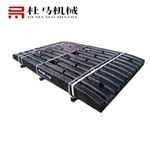


Cheek Plates And Side Liner Plates

Jaw crusher cheek plates and side liner plates are the last line of defense between abrasive feed rock and your crusher's steel frame. Once a liner fails, repair costs can exceed the cost of ten liner sets. Duma Machinery manufactures precision-cast cheek plates in Mn13, Mn18, and Mn22 grades with mandatory PT inspection on every batch—engineered for Metso, Sandvik, Terex, and Kleemann jaw crushers. OEM replacement, reverse engineering from worn samples, and small trial orders are all accepted.


What Are Jaw Crusher Cheek Plates & Side Liner Plates?
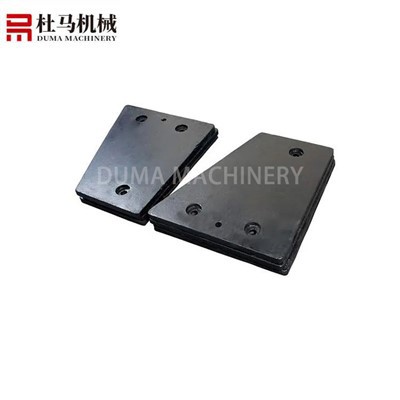
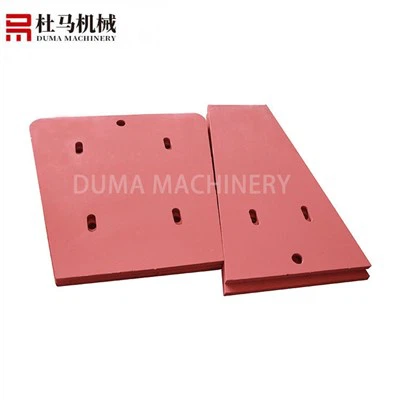
Jaw crusher cheek plates—also called side liner plates or side guard plates—are wear-resistant panels mounted on the inner side walls of the crushing chamber, between the fixed jaw and the swing jaw. Their function is twofold: first, they absorb lateral impact and abrasion from feed rock; second, they protect the crusher's main frame from direct material contact.
When a cheek plate wears through, rock particles begin to penetrate the frame itself. Unlike a liner replacement (a planned maintenance activity), frame repair requires the machine to be taken offline for weeks and often costs 10 to 20 times more than a set of new liners. This is why material selection, precise casting geometry, and consistent heat treatment are not optional—they directly determine your operating cost per ton.
Duma Machinery manufactures cheek plates from high-manganese steel grades (Mn13, Mn18, Mn22) and chromium-alloy upgrades, cast to match the exact installation geometry of Metso, Sandvik, Terex, Kleemann, and other major jaw crusher brands.

Cheek Plate & Side Liner Specifications
| Parameter | Standard Range |
|---|---|
| Material Grade | Mn13Cr2 / Mn18Cr2 / Mn22Cr2 |
| Initial Hardness (as-delivered) | HB 200–230 |
| Work-Hardened Surface Hardness | HB 450–550+ |
| Carbon Content | 1.0%–1.4% |
| Manganese Content | 13%–22% |
| Chromium Content | 1.5%–2.5% |
| Weight Range | 5 kg – 800 kg per piece |
| Heat Treatment | Water toughening / solution annealing (microcomputer-controlled) |
| Compatible Brands | Metso, Sandvik, Terex, Kleemann, Powerscreen, Telsmith, Trio |
| Lead Time (Standard Patterns) | 7–10 days |
| Lead Time (Custom Castings) | 35–45 days |
| MOQ | 1 piece (trial orders accepted) |
| Inspection | PT (Liquid Penetrant), Hardness, Dimensional, Metallographic |
Types of Cheek Plates & Side Liners We Supply
Casting Jaw Crusher Side Plate Liners
Cast in Mn18Cr2 or Mn22Cr2 for primary crushing duty. These are the thickest and heaviest liner profiles in our range, designed for large-format jaw crushers where feed sizes regularly exceed 600 mm. Compatible with Metso C140, C160, C200 and equivalent machines.
Jaw Crusher Upper Side Liner Plates
The upper liner sits at the material entry point and absorbs the initial kinetic energy of incoming rock. We cast these in Mn18Cr2 as standard, with Mn22Cr2 available for iron ore and hard basalt applications. Precise fit against the frame top edge is mandatory to prevent material bridging.
Jaw Crusher Lower Side Guard Plates
The lower liner is located in the highest-pressure zone of the crushing chamber—where material is at its most confined and forces peak. We reinforce the wall thickness of lower liners by 8–12% compared to upper liners and apply step-heating water toughening to ensure structural integrity through the full wear cycle.
Upper & Lower Combined Cheek Plate Sets
For customers replacing both liners simultaneously, Duma supplies matched sets dimensioned and weighed as a pair. Matched sets eliminate asymmetric frame loading and ensure balanced wear—extending total frame life and reducing per-set installation time.
Applications of Jaw Crusher Cheek Plates & Side Liners

Hard Rock Mining (Granite, Basalt, Quartzite)
These materials generate high surface abrasion. Mn18Cr2 liners work-harden rapidly under the scraping action of angular rock, reaching HB 500+ within the first operational hours. Recommended for primary jaw crushers in granite quarries and hard rock open-pit mines.

Iron Ore & Ferrous Metal Processing
Iron ore feeds combine heavy impact with moderate abrasion. Mn22Cr2 provides superior toughness under violent primary-stage vibration. Duma's step-heating quench process ensures the austenitic matrix remains stable even in sub-zero operating environments.

Limestone & Dolomite Quarrying
Softer materials require a balance between wear resistance and cost efficiency. Mn13Cr2 is our standard recommendation for limestone, delivering acceptable liner life without the material cost premium of higher-manganese grades.

Aggregate & Recycling Plants
Concrete and asphalt demolition waste often contains embedded steel rebar or wire, which creates extreme point-impact loading on liners. We supply Mn18Cr2 with an increased chromium content for recycling applications, improving resistance to sudden localized impact.

Cement Plant Primary Crushing
Limestone-based feeds in cement plant applications are high-volume and continuous-duty. Duma recommends matched sets on a scheduled replacement interval of every 800–1,200 operating hours, depending on feed hardness and crusher throughput.

Coal & Mineral Processing
Low-abrasion feed materials allow longer replacement cycles. Mn13Cr2 is cost-effective for these applications, with optional Mn18Cr2 upgrade if feed material is mixed or contains hard inclusions.
Why Choose Duma as Your Cheek Plate & Side Liner Supplier?
Direct Foundry — No Trading Markups
Duma is not a trading company. We operate our own 42,000 m² integrated foundry in Jiangxi Province, China, covering casting, heat treatment, machining, and quality inspection under one roof. Every price you receive is factory-direct, with no intermediary commissions built in.
4,000+ Verified Fit Patterns
Our pattern library covers Metso C-Series (C80 through C200), Sandvik JM and CJ Series, Terex Finlay and Pegson, Kleemann MC and MR Series, Powerscreen, Telsmith, Trio, and other regional brands. Most standard orders can begin production without new pattern development, which directly reduces your lead time and cost.
Mandatory PT Inspection on Every Batch
Surface micro-cracks are the single most common cause of premature liner failure in the field. Unlike many suppliers who perform PT as an optional or spot-check procedure, Duma subjects 100% of all cheek plates and side liners to Liquid Penetrant Testing before shipment. PT inspection reports are included as standard documentation.
Step-Heating Water Toughening — Not Just "Heat and Quench"
Standard quenching applies rapid temperature changes uniformly to the whole casting. For thick cheek plates, this creates a temperature differential between the core and the surface, generating internal thermal stress that manifests as micro-cracks within the first 200 operating hours. Duma's step-heating protocol—controlled by a microcomputer-managed furnace—brings the core and surface temperatures into equilibrium before quenching, eliminating this failure mode. The result: consistent austenitic structure throughout the full cross-section.
ISO 9001:2015 Certified Quality System
Every production stage—from incoming raw material inspection to final dimensional check—is governed by our ISO 9001:2015 certified quality management system. Each batch is accompanied by a material certificate, dimensional inspection report, hardness report, heat treatment curve, and metallographic report. These documents are available on request and provide the technical traceability required by most procurement departments.
OEM, ODM, and Reverse Engineering Capability
Customers who do not have original drawings can send worn samples or a part number. Our engineering team uses 3D scanning and coordinate measurement to reconstruct the original geometry, identify wear zones, and optimize wall thickness where needed. If you have drawings, we follow them precisely. OEM delivery with your branding and packaging is available for distributor customers.


How We Manufacture Cheek Plates & Side Liners
Step 1 — Raw Material Inspection
Incoming high-manganese steel alloy is tested for chemical composition via spectral analysis before entering production. Batches that do not meet ASTM A128 or GB/T 13932 requirements are rejected at intake.
Step 2 — Pattern Matching & Mold Preparation
For standard orders, we match your crusher model and frame dimensions against our 4,000+ pattern library. For new or non-standard models, we prepare a new sand casting pattern or lost foam casting mold based on drawings or scanned samples.
Step 3 — Casting
Molten high-manganese steel is poured at precisely controlled temperature. We use both sand casting (for standard profiles) and lost foam casting (for complex geometries). Post-pour, castings are allowed to cool under controlled conditions to minimize residual stress.
Step 4 — Step-Heating Water Toughening
Castings are loaded into our microcomputer-controlled furnace and brought to temperature via a graduated heating profile. Once the core and surface reach thermal equilibrium at the target austenitizing temperature (typically 1,050°C–1,100°C), the casting is transferred to a large-volume water tank with high-power circulation pumps. Forced water circulation ensures rapid, uniform quenching across the entire cross-section.
Step 5 — Precision Machining
Contact surfaces—those that mate with the crusher frame—are machined to specified dimensional tolerances. This ensures flush installation and eliminates the gaps that allow material ingress. We match the installation tolerances of Metso, Sandvik, and other OEM frames.
Step 6 — Full Inspection
Every casting passes through: hardness testing (HB verification), dimensional inspection (coordinate measurement), metallographic examination (confirming no carbide network), and PT inspection (surface integrity). Non-conforming parts are not shipped—they are scrapped and recast.
Step 7 — Documentation & Shipment
Each order ships with a full technical dossier: material certificate, inspection reports, heat treatment curve, and packing list. Export packaging is sea-freight rated for global shipping.
How to Order Custom Cheek Plates & Side Liners from Duma
Step 1 — Send Your Inquiry
Provide your crusher model, brand, part number, or attach a drawing or photo of the worn liner. If you have no documentation, our team can guide you through the measurement process.
1
>>
Step 2 — Receive Factory-Direct Quote Within 24 Hours
Our sales engineers confirm the pattern match, material grade recommendation, and pricing. Lead time and shipping options (FOB, CIF, EXW) are included in the quotation.
2
>>
Step 3 — Confirm Order & Production Begins
For standard patterns: production begins immediately. For custom patterns: engineering review and mold preparation take 3–5 days before casting.
3
>>
Step 4 — Inspection & Shipping
After full QC inspection, your order is packed and shipped. We provide the tracking number, inspection reports, and all export documentation.
4
>>
Step 5 — After-Sales Support
Our technical team remains available after delivery. For installation questions or any quality concerns, contact us via email or WhatsApp. Casting defects are covered by a 12-month warranty.
5
Our Factory & Equipment
Duma Machinery's production facility covers over 42,000 m² in Yushan County, Jiangxi Province, China—a purpose-built, integrated foundry established to serve global mining and quarrying customers. This is not a trading operation; every step of the manufacturing process takes place on-site.
Factory Capability at a Glance:
- Established: over 15 years in casting manufacturing for crusher wear parts
- Total facility area: 42,000 m² (foundry, heat treatment, machining, inspection, and storage)
- Monthly output: 1,000+ metric tons
- Annual output capacity: 10,000+ metric tons
- Pattern library: 4,000+ molds and patterns for global crusher brands
- Workforce: 200+ employees including dedicated engineering, metallurgy, and quality control teams
- Export reach: customers in Australia, South Africa, Chile, USA, Southeast Asia, and 30+ countries
- Key equipment: microcomputer-controlled heat treatment furnaces, large-volume water quenching tanks with forced circulation pumps, coordinate measuring machines, spectral analyzers, metallographic microscopes, UT (ultrasonic), MT (magnetic particle), and PT (liquid penetrant) testing equipment
We welcome factory visits. Customers who wish to audit our production process and quality systems are encouraged to schedule a visit to our Jiangxi facility.
Certifications & Quality Control
Duma Machinery holds ISO 9001:2015 certification, covering the full production process from incoming material inspection through final shipment.
Standard quality documentation per order:
- Chemical composition certificate (spectral analysis)
- Hardness test report
- Dimensional inspection report
- Heat treatment curve
- Metallographic examination report
- PT inspection report
- Packing list and shipping documents
Our metallographic inspection process conforms to ASTM A128 and GB/T 13932 standards for high-manganese steel castings. The absence of carbide network in the austenitic matrix is verified under high-magnification microscopy for every production batch.

Matching the Alloy to Your Application
| Feed Material | Recommended Grade | Reason |
|---|---|---|
| Granite / Quartzite | Mn18Cr2 | High abrasion; rapid work-hardening to HB 500+ |
| Iron Ore (Primary Stage) | Mn22Cr2 | High impact; superior toughness under violent loading |
| Limestone / Dolomite | Mn13Cr2 | Moderate abrasion; best cost-efficiency |
| Concrete / C&D Recycling | Mn18Cr2 (elevated Cr) | Mixed impact including rebar; improved point-load resistance |
| Basalt | Mn18Cr2 or Mn22Cr2 | Hard and dense; work-hardening essential |
| Coal / Mineral Ore (soft) | Mn13Cr2 | Low abrasion; longer replacement cycles |
Frequently Asked Questions About Jaw Crusher Cheek Plates & Side Liner Plates
Q: What are cheek plates also called?
A: Cheek plates are also referred to as side liner plates, side guard plates, or jaw crusher side liners. All of these terms describe the same component: the wear-resistant panels mounted on the inner side walls of the crushing chamber to protect the main frame.
Q: What manganese grade should I use for granite crushing?
A: Mn18Cr2 is the standard recommendation for granite and other high-abrasion hard rocks. The higher manganese content provides the work-hardening potential needed to reach HB 500+ under impact, which is necessary to resist the scraping action of angular feed material. For extremely hard or dense granite, Mn22Cr2 is an option.
Q: What is the difference between Mn13, Mn18, and Mn22?
A: The number refers to the approximate manganese content by percentage. Higher manganese content increases the material's capacity to work-harden under impact—reaching higher surface hardness during operation—but also affects initial cost. Mn13Cr2 is suitable for soft-to-moderate abrasion. Mn18Cr2 covers most hard rock applications. Mn22Cr2 is reserved for the highest-impact primary crushing duties such as iron ore and large-format primary crushers.
Q: What is work-hardening and why does it matter for cheek plates?
A: Work-hardening (strain-hardening) is the process by which high-manganese steel increases its surface hardness when subjected to repeated impact. A properly manufactured Mn18Cr2 cheek plate starts at approximately HB 200–230 as-delivered and can reach HB 450–550 during operation. This means the liner becomes harder and more abrasion-resistant as it is used—a key advantage over fixed-hardness materials.
Q: Why do some cheek plates crack early in service?
A: The most common causes are: (1) micro-cracks present at the time of installation (detectable by PT inspection), (2) inadequate heat treatment—particularly non-uniform quenching of thick castings—which creates internal thermal stress, and (3) incorrect alloy selection for the feed material. Duma addresses all three through mandatory PT inspection, step-heating water toughening, and application-specific alloy recommendations.
Q: How do I prevent cheek plates from loosening during operation?
A: Re-torque all mounting bolts within the first 2–4 hours of operation under load. As the manganese steel work-hardens and seats against the frame, bolt tension naturally decreases. Also, ensure the frame contact surfaces are thoroughly cleaned of dust, rust, and old liner material before installation—any debris creates a gap that allows the liner to move under impact.
Q: When should I replace my cheek plates?
A: Replace liners when wear reaches approximately 80% of original material thickness, or when crushing efficiency visibly declines. Continuing past this point risks exposing the frame to direct rock contact, which causes significantly more expensive damage. Duma can supply matched upper and lower sets on a planned replacement schedule if you provide your operating hours and throughput data.
Q: Can you manufacture cheek plates if I don't have original drawings?
A: Yes. You can send us your worn liner sample, the crusher model and brand, or a part number. Our engineering team uses 3D scanning and coordinate measurement to reconstruct the geometry. If you have a drawing, we follow it precisely to OEM tolerances.
Q: How do I verify cheek plate quality before placing a large order?
A: Request a trial order of 1–2 pieces for installation testing. Duma accepts trial orders with no minimum quantity requirement. We also provide the full inspection documentation—PT report, hardness certificate, dimensional report, and metallographic report—so you can verify quality through your own QA process before committing to volume.
Q: Are your cheek plates compatible with OEM jaw crushers from Metso and Sandvik?
A: Yes. Duma maintains a library of over 4,000 patterns for major global brands including Metso, Sandvik, Terex, Kleemann, Powerscreen, Telsmith, and Trio. Our machined contact surfaces match OEM installation tolerances to ensure flush fit and eliminate material ingress gaps.
Q: What is your delivery time?
A: For standard patterns already in our library: 7–10 days. For custom castings or new patterns: 35–45 days, including pattern development, casting, heat treatment, full inspection, and packaging.
Q: What is the minimum order quantity?
A: Duma accepts trial orders of 1 piece for quality verification purposes. There is no imposed minimum for blanket or repeat orders. Volume pricing is available for orders above certain thresholds—contact us for a quotation.
Q: What shipping terms do you offer?
A: We support FOB (Nanchang/Shanghai), CIF, and EXW terms. Door-to-door logistics assistance to major global mining regions is available on request.
Q: What documentation do you provide with each order?
A: Standard documentation includes: material composition certificate, hardness test report, dimensional inspection report, heat treatment curve, metallographic examination report, PT inspection report, commercial invoice, packing list, and bill of lading. Additional documents required for customs clearance can be arranged on request.
Q: Is your foundry ISO certified?
A: Yes. Duma Machinery is ISO 9001:2015 certified, covering the full scope of our manufacturing and quality management operations.
Q: Do you offer a warranty?
A: Yes. Duma provides a 12-month warranty against casting defects. In the event of a confirmed casting-related failure, we provide a full replacement.
Q: Can I visit your factory?
A: Yes. Factory visits are welcomed. Our facility is located in Yushan County, Jiangxi Province, China. Please contact us in advance to arrange your visit and we will coordinate the schedule.
Q: Why are Duma cheek plates priced lower than OEM originals?
A: You are purchasing directly from the manufacturing foundry, with no distributor or trading company margin between factory and customer. OEM original equipment manufacturers typically sell replacement parts through multi-tier distribution channels. Duma eliminates this markup while maintaining equivalent or higher inspection standards.
Q: Can you handle large blanket orders for mining operations?
A: Yes. Duma's monthly casting capacity exceeds 1,000 metric tons, with an annual output of 10,000+ metric tons. We have experience managing supply agreements for multi-crusher mining operations requiring continuous replenishment.
Q: Do your products comply with ASTM A128 standards?
A: Yes. Our high-manganese steel casting process and metallographic inspection procedures are conducted in conformance with ASTM A128 and GB/T 13932 standards.