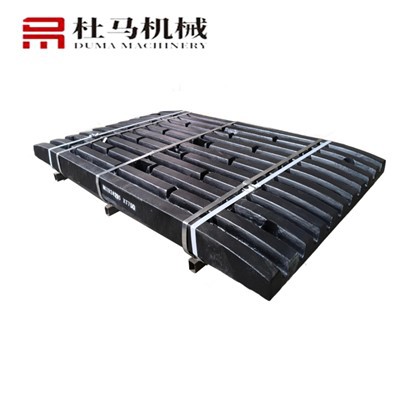
In the heavy-duty world of mineral processing and aggregate production, the versatility of equipment is paramount. A frequently debated topic among quarry managers and plant engineers is whether Crusher Jaw Plate components, typically associated with primary coarse crushing, can effectively bridge the gap into fine-crushing applications. As a direct manufacturer specializing in wear solutions, we often provide guidance on how to maximize the lifespan and efficiency of these components when operating parameters shift toward finer output requirements.

The Technical Reality of Fine Crushing with Jaw Crushers
While jaw crushers are fundamentally designed for primary reduction, they can indeed be adapted for secondary or finer crushing stages under specific, controlled conditions. However, the success of this transition relies heavily on the metallurgical integrity of the wear parts and the precision of the equipment setup.
Standard components, such as a Jaw Plate For Crusher, are engineered to manage significant impact forces. When shifting to fine-crushing, the mechanical stress profile changes. Instead of purely dealing with high-mass impact, the components face increased abrasive wear due to the higher frequency of material-to-metal contact as the discharge setting is narrowed. Therefore, the internal organization of the steel-specifically the austenite stability-becomes the defining factor in whether the part will last or fail prematurely.
Material Science: The Backbone of Durability
The transition to fine-crushing mandates a higher standard for the casting material. At our facility, we emphasize the importance of high-manganese steel (Mn13, Mn18, and Mn22) which undergoes rigorous heat treatment. Unlike generic parts, our process utilizes computer-controlled automated furnaces to perform precision water-toughening treatments. This ensures that the material achieves a stable austenitic structure, which is crucial for preventing brittle carbide precipitation-a common cause of failure in fine-crushing environments.
When a Jaw Crusher Upper Side Lining Plate or a main jaw plate is subjected to the continuous, smaller-scale impacts characteristic of fine-crushing, the "work-hardening" capability of manganese steel is tested. If the heat treatment is not performed with absolute precision, the material will not harden properly, leading to gouging rather than the intended surface hardening to HB500+ levels. Our in-house metallographic testing ensures that every batch maintains the integrity required for these demanding applications.

Design Optimization for Finer Particle Distribution
Achieving a finer output size requires more than just adjusting the closed-side setting (CSS) of the machine. The tooth profile of the Crusher Jaw Plate significantly influences the crushing dynamics. For primary applications, deep, aggressive teeth are standard to grab large boulders. For fine-crushing, these can lead to excessive production of elongated or flaky particles.
We often advise clients to switch to tooth profiles designed for finer granularity when the crusher is repurposed. These designs focus on increasing the inter-particle crushing effect, which is more efficient for producing a final product in the range of a few millimeters. Through our comprehensive mold inventory-which includes over 4,000 patterns-we can provide geometry that ensures the compression angle is optimized for secondary reduction without overloading the eccentric shaft or the toggle plate mechanism.
Precision Engineering and Fit Accuracy
One of the most overlooked aspects of fine-crushing efficiency is the fit accuracy between the liner and the crusher frame. When crushing to a finer specification, any movement or vibration of the liners caused by poor tolerance leads to localized pressure points. These points can cause premature cracking or "flow" of the manganese steel.
Our manufacturing process utilizes strict dimensional inspection protocols to ensure that every Jaw Plate For Crusher matches the original OEM specifications of major brands like Metso or Sandvik. By ensuring a perfect fit, we minimize the gap between the liner and the frame, allowing the crusher to maintain a stable discharge opening, which is non-negotiable for consistent fine-crushing performance.
Maintenance Strategies for Extended Wear Life
Fine-crushing is inherently more abrasive. To manage this, we advocate for a proactive maintenance culture rather than a reactive replacement cycle. Our technical team suggests the following best practices:
- Initial Inspection: Within the first 48 hours of operation, all bolts and wedge systems must be checked for tightness to ensure the plates are fully seated against the frame.
- Inversion Strategy: For many jaw sets, employing an inversion strategy-flipping the plates when the lower portion reaches 50% wear-can double the utility of the manganese alloy, significantly lowering the total cost of ownership.
- Monitoring: Use the provided technical documentation, including the hardness and metallographic reports we supply with each batch, to track the wear rate against your specific feed material hardness.
Why In-House Production Matters
As a direct factory-based entity, we control the entire lifecycle of our products, from raw material inspection to the final dimensional check. This allows us to provide traceability that trading companies cannot match. When you purchase a Jaw Crusher Upper Side Lining Plate from us, you are not just getting a piece of metal; you are getting a documented solution supported by a 12-month warranty against casting defects.
Our ability to handle custom orders based on reverse engineering of worn samples means that if your fine-crushing application requires a specialized alloy composition, such as an upgrade to Mn22 or the integration of titanium carbide inserts, we can develop and deliver that solution within a 35-45 day window.
Conclusion: Choosing the Right Partner
Successfully utilizing jaw crusher components for fine-crushing is entirely possible if you prioritize material metallurgy and fit precision. By choosing a manufacturer that understands the science of steel and the mechanics of the crushing chamber, you can turn a versatile jaw crusher into a highly efficient production unit for finer materials.
If you are looking to optimize your site's performance, we invite you to reach out to our technical consulting team. We can analyze your current ore type, provide a comparative assessment of your wear rates, and help you select the exact alloy and profile to meet your production targets. Contact us today to discuss your specific requirements and learn how our in-house manufacturing can stabilize your supply chain and reduce your downtime.