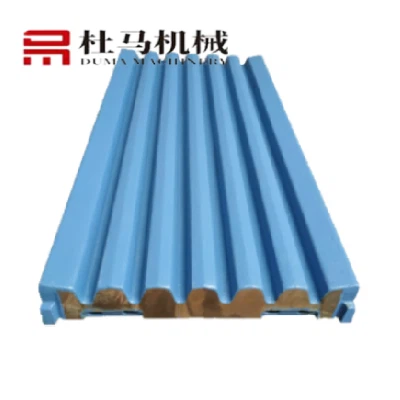
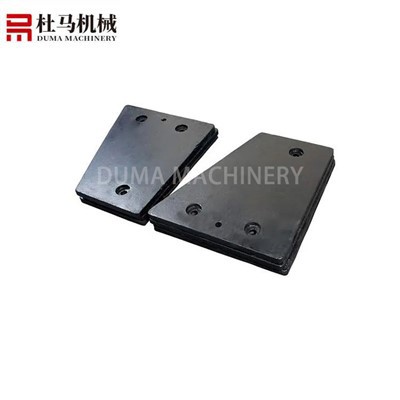
In the heavy-duty world of primary crushing, the Gyratory Crusher Upper Mantle is the heart of the operation. Unlike secondary or tertiary crushers, the primary gyratory crusher is the first point of contact for run-of-mine ore. Consequently, the upper mantle must endure extreme impact, massive throughput, and varying geological challenges. As a direct-factory manufacturer, Duma understands that an upper mantle is not just a casting; it is a precision-engineered solution that must adapt to the specific mineralogy of your site.

1. The Critical Role of Material Metallurgy in Adaptability
Adaptability starts with the metallurgical composition. A common misconception in the industry is that a harder material is always better. However, for a Gyratory Crusher, the balance between hardness and fracture toughness is the deciding factor for service life.
- Work-Hardening Manganese Steels (Mn13, Mn18, Mn22): For high-impact applications where ore feed size is large and unpredictable, manganese steel remains the gold standard. Our precision casting process ensures a stable austenitic microstructure that rapidly work-hardens under impact, creating a tough, wear-resistant surface while maintaining a ductile core to prevent breakage.
- Alloyed Manganese Steels (Mn18Cr2): When dealing with moderately abrasive ores, we recommend adding chromium to the manganese matrix. This creates a refined grain structure that resists abrasive wear significantly better than standard manganese steel, while retaining the toughness required for primary crushing.
- Composite and Insert Solutions: For extremely abrasive environments where traditional manganese steel wears too quickly, we utilize advanced composite inserts. By integrating high-wear-resistant materials in critical wear zones, we provide a mantle that resists erosive "gouging" while the base structure absorbs the massive crushing force.
2. Geometry and Profile Adaptability for Different Ore Types
The profile of the upper mantle determines how the ore is gripped and crushed. An mismatched profile leads to energy waste, poor particle size distribution, and premature mechanical stress on the crusher mainframe.
- Hard and Abrasive Ores (e.g., Quartzite, Granite): These ores require a steep-angle mantle profile to maximize the "nipping" force. A thicker mantle section is necessary here to provide the thermal mass and structural volume required for long-term survival under constant, high-pressure impact.
- Soft and Friable Ores (e.g., Limestone, Phosphate): Friable materials require a shallower slope. Our engineers often suggest a design that emphasizes high throughput and reduces the "dwell time" of the material in the crushing chamber. This prevents over-crushing, which can lead to excessive dust generation and unnecessary energy consumption.
- Sticky and Clay-Rich Ores: The primary challenge here is bridging and packing. We design upper mantles with optimized tooth geometries that promote self-cleaning, preventing the material from building up and causing the crusher to "choke."
3. Why Factory-Direct Precision Matters
Adaptability is also a matter of fit. A Gyratory Crusher Liner and Mantle must sit perfectly against the main shaft and the concave frame. At our 42,000 m² facility, we employ micron-level machining tolerances. If a mantle has even a slight gap, it will shift during the crushing cycle, causing microscopic vibrations that lead to cracks or even damage to the expensive main shaft assembly.
Our "fit-first" approach means that every batch of liners is checked for dimensional accuracy against OEM specifications (such as Metso or Sandvik models). This ensures that once the component is installed, it is essentially a seamless extension of the crusher itself.

4. Data-Driven Maintenance and Documentation
To truly adapt your crushing operation to the ore, you need data. We don't just supply a part; we supply a technical file. This includes:
- Metallographic Analysis: Confirming the grain size and carbide distribution, ensuring the mantle will perform as expected in your specific environment.
- Hardness Profile Reports: Tracking how the material reacts to impact over time.
By keeping these technical records, your maintenance team can correlate tonnage throughput with the specific wear rates of your Crusher Wear Spare Parts. If you notice an accelerated wear rate, our engineering team can use this data to recommend a geometry or alloy change in the next production batch, creating a feedback loop that lowers your cost-per-ton.
5. Partnering with Duma for Custom Solutions
No two mining sites are identical. Whether you are dealing with high-silica iron ore in South Africa or softer aggregate in Australia, the ability of your crusher to adapt is the difference between profit and loss.
Our process begins with an initial consultation to analyze your site's ore hardness, abrasiveness, and feed distribution. From there, our engineering team utilizes the latest in 3D modeling and stress analysis software to design a Gyratory Crusher Upper Mantle that is purpose-built for your equipment.
We invite you to reach out to our team to discuss your operational challenges. We are committed to providing the technical expertise and the high-quality castings necessary to keep your primary crushing station running at peak performance. Contact us today to learn how our direct-factory advantage can transform your site's operational efficiency.