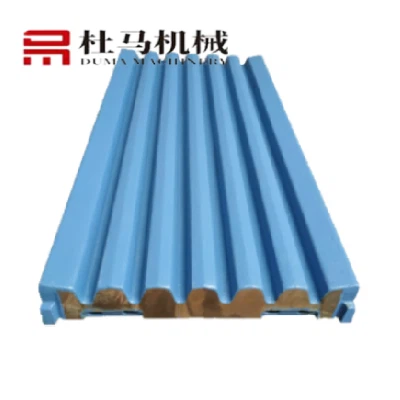
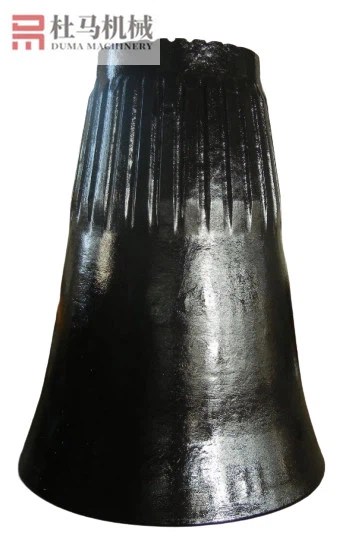
In the sphere of high-efficiency crushing, the cone liner is not a static piece of metal-it is the engineered interface where mechanical energy is transferred into comminution energy. As a manufacturer operating 42,000 m² of specialized facilities, we emphasize that the surface texture and geometry of your Crusher Cone Liners are the primary determinants of crushing efficiency, product shape, and operational costs. Understanding how these textures influence material flow is essential for maximizing your crusher's ROI.

The Mechanics of "Interparticle Crushing"
The primary function of a cone crusher is to induce "interparticle crushing," where rocks are crushed against other rocks rather than solely against the metal liner. The surface texture of the Mantle and Concave is engineered to facilitate this phenomenon.
- Frictional Grip and Material Movement: A textured surface provides the necessary friction to prevent material slippage. If the liner were perfectly smooth, the feed would slide along the metal surface rather than being compressed. Our specialized rib profiles and tooth patterns ensure that the material is trapped and compressed, maximizing the impact-to-energy ratio.
- Flow Control and Velocity: The topography of the liner-specifically the depth and angle of the grooves-acts as a flow-control mechanism. By strategically designing these features, we can optimize the speed at which material descends through the crushing chamber, ensuring the material remains in the "crushing zone" for the optimal amount of time.
Optimizing Product Shape: The Quest for Cubical Aggregates
In the construction and aggregates industry, the shape of the output is just as important as the size.
- The Cubical Advantage: A liner with an aggressive, optimized texture produces a more cubical product. This is because the design promotes controlled fracturing rather than chaotic shattering. Cubical aggregates exhibit superior interlock properties, which are critical for high-strength concrete and stable road foundations.
- Matching Texture to Hardness: We offer custom-engineered textures for our Mn18Cr2 Concave and Mantle series. For instance, harder, more abrasive ores require a smoother profile to prevent premature wear, while softer, slabby materials benefit from a more aggressive texture that forces the material to reorient itself, thereby breaking it into more uniform dimensions.

Energy Efficiency and Thermal Management
Inefficient crushing is often masked by high energy consumption. If your crusher is drawing excessive amperage without a proportional increase in throughput, the issue often lies with the surface texture of the liners.
- Reducing Attrition: When liners lack the correct texture, material tends to rub against the liner surface (attrition) rather than fracturing. Attrition consumes massive amounts of energy and generates heat that can compromise the metallurgical integrity of the manganese steel.
- Optimized Throughput: By employing a texture that effectively channels material and minimizes slippage, we ensure that every stroke of the mantle contributes to material reduction. This operational efficiency directly translates to lower power consumption per ton of finished product.
Metallurgy and Dimensional Precision
At Duma, we recognize that texture is irrelevant if the dimensional integrity fails. Our manufacturing process ensures that the texture remains consistent throughout the entire wear lifecycle of the part.
- Fit Accuracy: Our liners, including the Cone Crusher Replacement Parts we manufacture, undergo rigorous dimensional inspection. A liner that fits with micron-level precision prevents material from becoming trapped behind the mantle, which could otherwise deform the metal and ruin the designed surface topography.
- Metallurgical Consistency: Using our state-of-the-art water-quenching process, we ensure that the wear-resistant properties of our alloys (like Mn18Cr2) are uniform. This means that as the liner wears down, the "texture" remains as effective on the last day of its service life as it was on the first.
Selecting the Right Profile for Your Operation
Selecting the wrong surface texture can be costly. If you are experiencing excessive fines, poor product shape, or high energy costs, it is time to audit your liner profile.
- Conduct a Feed Analysis: Assess the hardness and abrasiveness of your ore.
- Consult Our Engineering Team: We use advanced simulation tools to predict how different liner textures will behave with your specific material feed.
- Pilot Testing: We offer small-batch runs of specialized liners to allow you to test how different surface profiles affect your final aggregate quality.
Conclusion: Precision Engineering for Maximum Yield
The surface texture of your Crusher Cone Liners is a critical engineering parameter, not an aesthetic choice. By fine-tuning the geometry of your mantle and concave, you can achieve a higher percentage of cubical products, reduce your energy footprint, and significantly extend the life of your equipment.
At Duma, we are dedicated to providing more than just wear parts; we provide the metallurgical and engineering expertise to optimize your entire crushing process. If you are ready to refine your crushing performance, contact our technical team today. Let us help you select the optimal texture and material for your specific operational challenges.