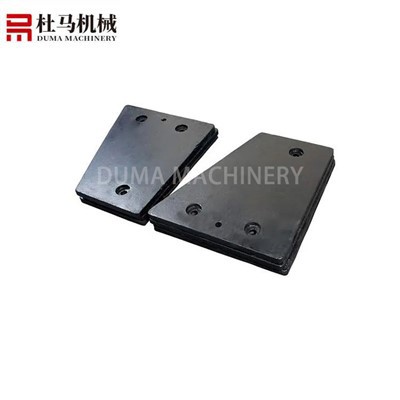
In the demanding world of aggregate processing and recycling, mobile jaw crushers operate under intense stress, heavy impact, and continuous abrasion. Selecting the right replacement wear components is vital for maximizing uptime and reducing operational expenditures. Among various alloy options, Mn18 high-manganese steel holds a premier position. As a dedicated manufacturer and supplier of Replacement Crusher Jaws, we frequently receive inquiries regarding the precise density of Mn18 and its direct implications for mobile crushing performance.

The Fundamental Density of Mn18 High-Manganese Steel
The density of Mn18 is typically around $7.8\text{ g/cm}^3$. This physical metric represents the mass per unit volume of the alloy. While $7.8\text{ g/cm}^3$ serves as the standard baseline, slight variations can occur based on exact chemical compositions, minor trace elements, and specific thermal processing techniques.
For operators of mobile jaw crushers, understanding this density is more than just a theoretical exercise. It directly influences component mass, structural balance, and the overall kinetic behavior of the crushing equipment during heavy rock reduction.
How Density Impacts Structural Integrity and Machine Stability
Mobile jaw crushers require components that provide substantial mass without compromising the mobility and agility of the chassis. The robust density of Mn18 ensures that parts like the Jaw Plate Jaw Fixed Jaw Crusher possess the necessary heft to withstand massive compressive loads.
Enhanced Inertial Stability: The consistent mass provided by a $7.8\text{ g/cm}^3$ density helps absorb and dampen high-frequency vibrations during primary rock reduction.
Frame Protection: Heavy, dense components prevent excessive shifting within the crushing chamber, safeguarding the structural framework of mobile units from premature fatigue and misalignment.
The Synergy Between Density, Work-Hardening, and Wear Resistance
Density alone does not guarantee long service life; the internal microstructural integrity of the alloy is equally critical. Mn18 contains approximately 18% manganese, which gives it exceptional work-hardening capabilities under continuous impact.
Initial vs. Hardened State: Components typically exhibit an initial baseline hardness of around HB200. Under severe compressive forces from hard rocks and ores, the surface rapidly work-hardens to exceed HB500.
Prolonged Component Lifespan: The dense, compact atomic structure ensures that high-impact components such as High Manganese Jaw Crusher Parts maintain dimensional integrity over extended operational cycles.
In-House Manufacturing and Rigorous Quality Control Standards
Achieving and maintaining a stable density requires advanced metallurgical control. Operating from an expansive, direct-sale manufacturing facility covering over 42,000 square meters, production processes are meticulously managed from raw material melting to final finishing.
Advanced Heat Treatment: Every batch undergoes computer-controlled solution heat treatment, commonly known as water toughening or water quenching, utilizing high-power circulation pumps to stabilize the austenitic structure.
Metallographic Examination: High-magnification microscopy ensures zero network carbide precipitation, guaranteeing that the steel remains tough and resistant to catastrophic early fracture.
Full Batch Traceability: Comprehensive quality assurance protocols include strict dimensional checks, hardness verification, and complete material test reports for every production run.

Precision Fit and Multi-Brand Compatibility
Mobile jaw crushers demand absolute dimensional accuracy to ensure swift maintenance turnarounds. Maintaining strict manufacturing tolerances ensures that replacement parts integrate seamlessly into various global machinery brands.
Utilizing an extensive pattern database comprising over 4,000 designs, components are engineered for exact compatibility with leading mobile and stationary equipment lines, including Metso C-series and Sandvik CJ-series crushers. This precision eliminates the need for on-site modification or grinding, ensuring a ready-to-install solution that minimizes field downtime.
Wholesale Support, Customization, and Flexible Procurement
As an established direct-sale factory rather than a trading intermediary, operations are structured to support global B2B clients, regional distributors, and large-scale aggregate producers with maximum efficiency:
- Mass Production and Rapid Supply: Maintaining a massive monthly production capacity backed by extensive stock for popular standard models allows for fast dispatch within 7 to 10 days. Custom or non-standard castings are typically delivered within 30 to 45 days.
- Custom Alloy Engineering: Beyond standard Mn18 formulations, tailored solutions such as Mn22 or titanium carbide (TiC) inserts can be engineered based on specific abrasive job-site conditions or customer-provided wear samples.
- Trial Orders Welcome: To help new partners verify material performance and work-hardening efficiency firsthand, flexible low-quantity trial orders are fully supported.
Conclusion
The density of Mn18, hovering steadily around $7.8\text{ g/cm}^3$, serves as a foundational pillar for the durability and efficiency of mobile jaw crusher wear components. By combining precise material density, advanced water-quenching protocols, and strict quality traceability, operators can significantly lower maintenance overheads and boost overall productivity.
If you are looking to optimize your mobile crushing fleet with reliable, high-performance wear solutions, contact our technical team today to discuss your specific operational requirements or request a custom batch quotation.