

Choosing the right jaw plate for a crusher is not just about finding a spare part that fits; it's about balancing metallurgy, dimensional precision, and application-specific engineering to minimize downtime and maximize tons-per-hour output.
As a direct-investment manufacturing entity with a 42,000 m² foundry and machining workshop , DUMA breaks down the critical technical parameters you must evaluate before issuing your next procurement order to ensure maximum component lifespan and processing efficiency.
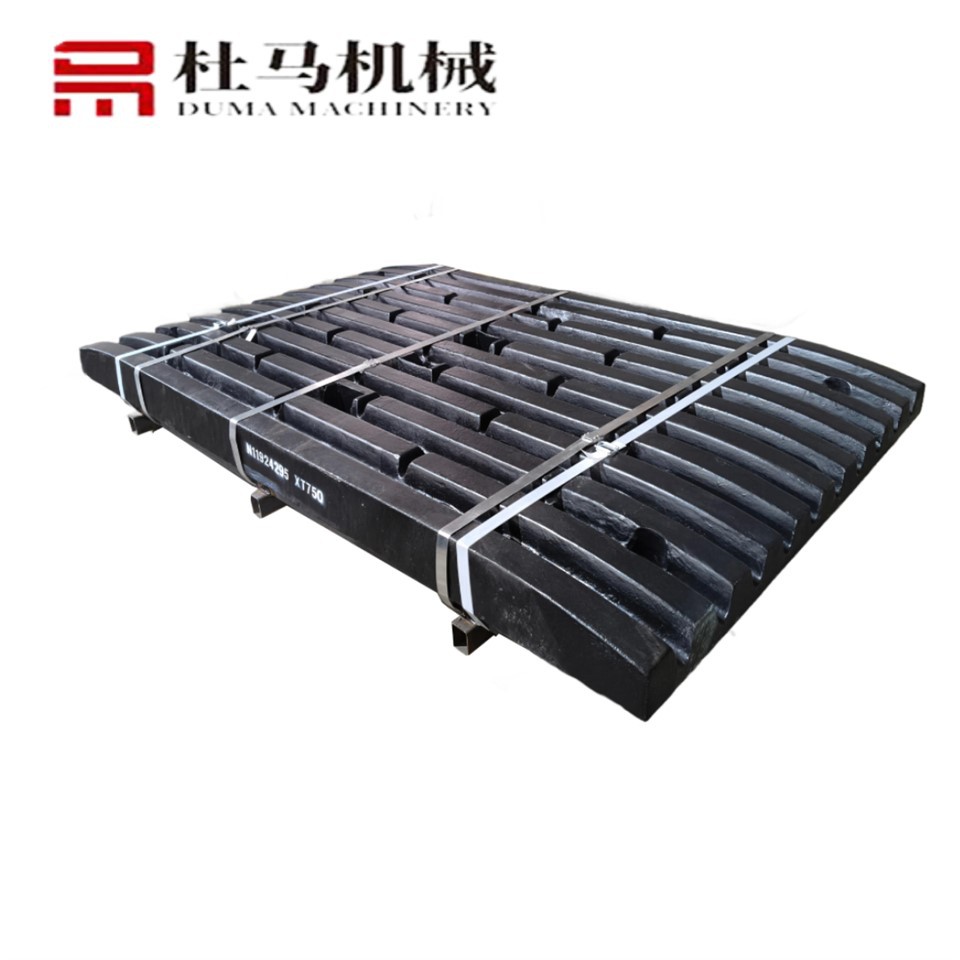
1. Material Composition & Metallurgy (The Foundation of Wear Life)
The chemical and microstructural composition of a jaw plate dictates its resistance to high-impact abrasion. Standard solutions typically utilize high-manganese steel grades like Mn13, Mn18, or Mn22 to withstand the extreme working conditions inside the crushing chamber.
According to international standards like ASTM A128 and GB/T 13932, the ideal microstructural parameter for these alloys must be a single, pure Austenite matrix. At DUMA, we utilize high-magnification Metallographic Testing and computer-aided image analysis to ensure there is zero network carbide precipitation at the grain boundaries. This precise metallurgical control prevents premature cracking and guarantees our "tough but not brittle" performance under heavy loads. For highly abrasive quartz or granite crushing, elements like Chromium (Cr) can be added to boost baseline wear resistance, while custom TIC (Titanium Carbide) inserts can be engineered for severe applications.
2. Hardness & The Work-Hardening Phenomenon
A common misconception in procurement is focusing solely on the "out-of-the-box" hardness of the casting. The true value of high-manganese steel lies in its unique behavior under operational stress.
Following professional Water Toughening (Quenching) via high-power forced water circulation , premium manganese jaw plates carry an initial baseline hardness of approximately HB 200 (Brinell Hardness). However, under continuous material impact, the surface layer undergoes rapid transformation, hardening from HB 200 to over HB 500. This creates an extremely hard outer skin that resists heavy abrasion while maintaining a ductile core that absorbs high-energy impacts without snapping. DUMA's automated microcomputer-controlled heat treatment furnaces apply precise "step-by-step" heating curves to ensure that this work-hardening potential is consistent across every single batch produced.
3. Dimensional Tolerances & Fit Accuracy
Even the best alloy is useless if the plate fails to seat properly inside the crusher frame. Heat treatment naturally introduces thermal deformation, which top-tier manufacturers must control at a micro-level during final machining.
DUMA performs a strict dimensional inspection on all parts to guarantee precise alignment with the installation tolerances of major global OEMs. Our engineering database covers over 4,000 sets of patterns , ensuring exact compatibility with models such as the Metso C-Series (C80, C100, C125, C160), HP/GP Series, and Sandvik CJ/CH Series. This "ready-to-use" accuracy eliminates the need for costly and time-consuming on-site grinding or modifications by your maintenance team, ensuring seamless stability from day one.
4. Tooth Profiles & Application Tailoring
The geometry of the teeth directly impacts the crushing capacity (measured in tons per hour) and energy consumption. Selecting the wrong profile accelerates localized wear and chokes production. DUMA provides specialized wear analysis to match the parameters of your profile to your specific ore characteristics:
- Standard / Straight Teeth: Ideal for non-abrasive, medium-hard rocks, providing uniform crushing force for general-purpose applications.
- Quarry / Heavy Duty Teeth: Features thicker profiles designed to handle highly abrasive feed material without flattening prematurely.
- Super Grip / Sharp Teeth: Excellent for recycling concrete or handling slippery, layered stones, as they penetrate raw materials more efficiently to maintain peak output.
To maximize your return on investment, we highly recommend implementing an Inversion Strategy for your jaw plates. When the lower 50% section of your fixed or movable jaw plate shows advanced wear, flip the plate upside down. This simple operational adjustment redistributes the crushing zone stresses, balances overall wear, and extends the aggregate wear life of the plate by 20% to 40%.
5. Production Reliability & Technical Traceability
When sourcing in bulk or managing large-scale mining operations, supply chain transparency and batch consistency are vital technical safeguards.
Every single jaw plate should be backed by verifiable data. Because DUMA manages an all-in-house production cycle across our 42,000 m² facility-from raw material testing and melting to non-destructive testing (including UT, MT, and PT)-we ensure absolute technical traceability. Each delivery is backed by a complete technical dossier, including Material Certificates, Dimension Logs, Heat Treatment Curves, and Metallographic Reports. This level of documentation guarantees that your reordered parts will perform exactly like your initial trial order.

Conclusion: Finding Your Optimal Parameters
Understanding the mechanical and metallurgical parameters of jaw plates protects your crusher's eccentric shaft, toggle plates, and main frame from unnecessary stress.
Whether you need standard replacement items for a C160 crusher or custom-engineered OEM/ODM configurations mapped from worn sample reverse-engineering , DUMA's engineering team is ready to provide comprehensive wear analysis and material consultations.
Looking to optimize your crusher's cost-per-ton metrics? Contact our 24/7 technical support and procurement teams today to request a quick quote, obtain comprehensive customs documentation (FOB, CIF, EXW), or discuss your specific trial-order requirements.
References
ASTM A128 / A128M – Standard Specification for Steel Castings, Austenitic Manganese.
ISO 9001:2015 – Quality Management Systems Certification.
DUMA Internal Metallurgy & Quality Assurance Laboratory Standards – Technical Data Sheets for High-Manganese Series.


