


Hard basalt in the mountains and massive granite on construction sites are turned into evenly sized crushed stones, then laid into the roads beneath our feet and mixed into the concrete of high-rise buildings. All of this is what a cone crusher does best. However, if it is not operated properly, it can easily become overloaded, causing uneven cone crusher mantle wear and greatly reducing the machine's service life. So, what materials is a cone crusher good at crushing, and which ones are not suitable?
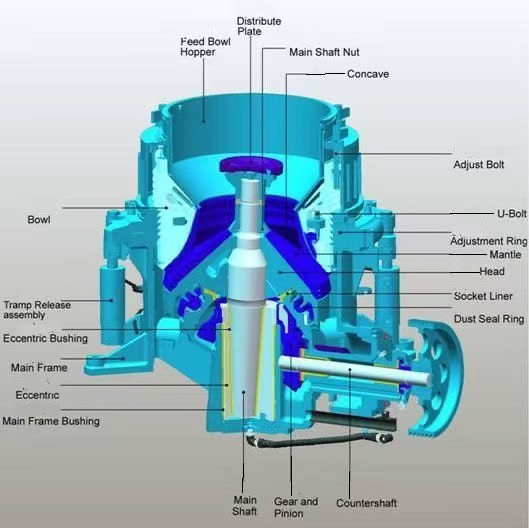
First, we need to understand the main structure of a cone crusher.
Frame: The "backbone" of the entire machine, made of cast steel or welded structure. A large unit can weigh dozens of tons. Its function is to support all components and withstand the huge impact forces generated during crushing.
Concave: The fixed part installed on the frame. It consists of the concave and liner, forming the crushing chamber together with the mantle and providing the surface for compression.
Mantle: The core moving part, which performs an eccentric swinging motion around the main shaft. It continuously moves closer to and farther from the concave, with a liner on its outer surface, crushing the material through repeated compression.
Eccentric Sleeve: The key component that enables the mantle to swing. The motor drives the eccentric sleeve to rotate, and its eccentric structure causes the mantle to move in a circular motion.
Main Shaft: Connects and supports the mantle, transmitting the crushing force.
Feed/Discharge Opening: Material enters from the top and exits from the bottom, with adjustable size.
Protection Device: Prevents equipment damage. When uncrushable materials enter, it allows the chamber to "release" pressure and avoid serious damage.
Lubrication System: Supplies oil to high-speed moving parts to prevent overheating and wear.
After understanding the structure, it's easy to see that the working principle of a cone crusher is quite simple-like cracking a nut with your hands, but on a larger and more precise scale.
The process can be divided into three steps:
Feeding: Material enters from the top and falls between the mantle and concave.
Crushing: The motor drives the eccentric sleeve, which makes the cone crusher mantle swing around the main shaft, compressing and crushing the material repeatedly.
Discharging: Hard rocks are gradually ground into smaller pieces until they can pass through the bottom opening and fall out automatically.
Many scenarios in our daily life rely on this machine. Whether it's iron ore, copper ore, or gold ore, raw materials extracted from the ground must first be crushed into smaller particles before entering the next stage of processing. Concrete for buildings and asphalt roads also require uniformly sized aggregates as raw materials.

DUMA Cone Crusher Parts Mantle
Next, let's take a closer look at the types of materials it can handle:
High-hardness rocks: This is the most typical and ideal application for cone crushers. Materials like granite, basalt, quartzite, and ores are hard and wear-resistant, and can be efficiently crushed while maintaining uniform particle shape.
Medium-hardness rocks: Limestone, dolomite, sandstone, and some shale are moderately hard and easy to crush. They offer high output, low energy consumption, and excellent particle shape.
Metal ores: Copper ore, gold ore, iron ore, lead-zinc ore, and nickel ore. After primary crushing with a jaw crusher, a cone crusher is used for secondary and fine crushing, providing suitable particle size for further grinding and improving beneficiation efficiency.
Artificial sand and aggregates: High-grade road aggregates and concrete aggregates with uniform particle size.
Recycled materials: Processed waste concrete and demolition materials (after removing rebar, wood, plastics, and other impurities).
Click here Explore more about materials and their applications.

Of course, a cone crusher is not suitable for everything. The following materials are not recommended:
High-moisture materials: Clay, wet soil, and sticky ores can easily adhere to the crushing chamber and cause blockages.
Soft materials: Coal and gypsum are better suited for impact or hammer crushers, as cone crushers are less efficient for these materials.
Materials with impurities or foreign objects: As mentioned above, concrete with rebar or mixed industrial waste can damage liners, cause blockages, or even lead to serious machine failure and high repair costs.
Even for suitable materials, performance can be affected by various factors. Higher hardness reduces output and increases wear; high moisture can cause blockages; oversized feed can reduce efficiency or damage the machine; and excessive fines or clay can lower product quality.
In summary, cone crushers are best suited for: crushing hard materials, meeting high production demands, and producing high-quality aggregates. With proper maintenance-such as regularly replacing liners and checking the lubrication system-the machine can run longer and more reliably.


