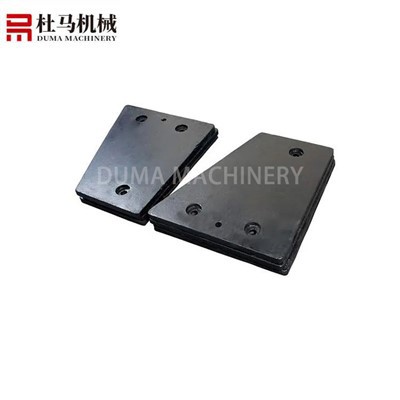
Hey there! As a supplier of Jaw Crusher Liners, I've seen firsthand how the shape of these liners can make a huge difference in the crushing performance. So, let's dive into how the shape of jaw crusher liners affects the whole process.
First off, let's understand the basic job of jaw crusher liners. They're the parts that come into direct contact with the material being crushed. When the jaws move, the liners apply pressure to break down the rocks or whatever else you're trying to crush. And the shape of these liners can really change up how well that happens.
One of the most common shapes for jaw crusher liners is the straight - face design. Liners with a straight face are pretty simple in terms of their shape. They've got a flat surface that goes from the top to the bottom of the liner. This shape is great for primary crushing operations. Why? Well, it provides a uniform crushing force across the material. When you've got large chunks of rock coming in, the straight - face liner can apply pressure evenly, breaking the rocks down into more manageable sizes. It's like using a big, flat hammer to crack open a nut.
But here's the thing, straight - face liners might not be the best for all types of materials. If you're dealing with softer or more brittle materials, you might end up with over - crushing. That means the material gets broken down into smaller pieces than you actually need, which can waste energy and time.
Now, let's talk about serrated or corrugated liners. These liners have a series of ridges and grooves on their surface. The shape of these serrations can vary in terms of depth, width, and spacing. Serrated liners are excellent for gripping the material. When the jaws close, the ridges dig into the rocks, providing a better hold. This is super useful when dealing with hard, abrasive materials that are difficult to break. The serrations help prevent the material from slipping out of the jaws before it's properly crushed.
For example, if you're crushing granite, which is a very hard rock, a serrated liner will grip it tightly and apply more concentrated force at the points of contact. This makes it easier to break the granite into smaller pieces. You can think of it like using a pair of pliers instead of a flat - faced hammer. The pliers can grip the object better and apply more targeted force.
However, serrated liners also have their drawbacks. Over time, the serrations can wear down, especially if you're constantly crushing very hard materials. Once the serrations start to wear, their gripping ability decreases, and the crushing performance can drop. You might need to replace these liners more often compared to straight - face liners.
Another shape option is the convex or concave liner. Convex liners bulge outwards in the middle, while concave liners curve inwards. These shapes are designed to control the flow of the material through the crusher. A convex liner can push the material towards the sides of the crusher, which can be useful for spreading out the crushing force and reducing the risk of clogging. On the other hand, a concave liner can pull the material towards the center, concentrating the crushing force in a specific area.
If you're dealing with a large volume of material, a convex liner might be a good choice. It helps keep the material moving smoothly through the crusher, preventing it from piling up in the middle. But if you want to get a more precise crush on a particular type of material, a concave liner could be better. It allows you to focus the force where it's most needed.
Now, let's touch on the importance of choosing the right liner shape for your specific application. As a Jaw Crusher Liners supplier, I often get customers asking for advice on which liner shape to use. It all depends on a few factors. First, you need to consider the type of material you're crushing. Is it hard, soft, brittle, or abrasive? Different materials respond better to different liner shapes.


Second, think about the size of the material. If you're starting with large boulders, you'll need a liner that can handle that initial break - down. For smaller feed sizes, you might be able to get away with a liner that's more focused on fine - tuning the crush.
Third, consider your production goals. Are you looking to produce a large volume of a certain size of crushed material? Or are you more concerned with getting a high - quality, uniform product? The shape of the liner can have a big impact on both the quantity and quality of your output.
At our company, we offer a wide range of liner shapes to meet different customer needs. You can check out our Fixed And Moveable Jaw Plate which come in various shapes and are suitable for different types of jaw crushers. Our Mn18 For Mobile Jaw Crusher is another great option, especially if you're using a mobile crusher. And don't forget to look at our Jaw Fixed Plate And Swing Plate which are designed to provide optimal crushing performance.
If you're still not sure which liner shape is right for you, don't hesitate to reach out. We've got a team of experts who can help you make the best choice based on your specific situation. Whether you're a small - scale quarry operator or a large - scale mining company, we're here to make sure you get the most out of your jaw crusher.
In conclusion, the shape of jaw crusher liners plays a crucial role in the crushing performance. Different shapes offer different advantages, and choosing the right one can improve efficiency, reduce wear and tear, and increase the quality of the crushed product. So, take the time to evaluate your needs and pick the liner shape that's going to work best for you. If you're interested in purchasing our jaw crusher liners or have any questions about our products, just get in touch. We're looking forward to helping you achieve better crushing results.
References
- Smith, J. (2018). "The Impact of Liner Design on Crushing Efficiency". Journal of Mining and Quarrying Technology.
- Brown, A. (2020). "Optimizing Jaw Crusher Performance with the Right Liners". International Journal of Rock Mechanics.
- Johnson, R. (2019). "Understanding the Role of Liner Shape in Jaw Crushers". Mining Engineering Review.