


Introduction: The Cost of the Wrong Choice
You've just scheduled an unplanned shutdown. Again.
The bowl liner on your secondary cone crusher wore out in under 400 hours - half the life you budgeted for. Your maintenance crew is pulling the machine apart, your conveyor is idle, and every hour of downtime is bleeding money. You ordered the same grade you always order. So what went wrong?
This is one of the most common and costly problems in hard rock mining operations - not equipment failure, but material mismatch. The bowl liner (the fixed outer wear component inside a cone crusher that forms the crushing cavity together with the mantle) is a precision wear part, not a commodity. In copper, gold, iron ore, and granite operations, the difference between the right alloy grade and the wrong one can mean the difference between 350 working hours and 700+. Same machine. Same rock. Different liner grade.
This guide cuts through the confusion and gives you a practical, decision-ready framework for alloy selection - built on the actual mechanics of how manganese steel behaves under hard rock crushing conditions.
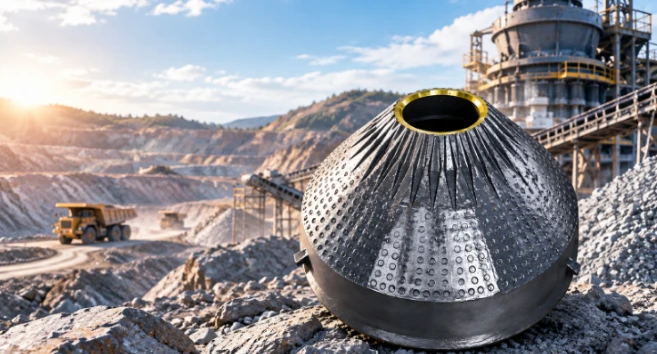
Engineered for Extreme Wear. Built for Hard Rock Crushing
How Manganese Steel Actually Works - and Why It Matters
·
All standard concave and bowl liners are cast from austenitic high-manganese steel, a material first developed by Sir Robert Hadfield in 1882. What makes it uniquely suited to crushing is its work-hardening mechanism: when the liner surface is struck repeatedly under compressive force, the steel's microstructure dislocates and densifies, forming a hard, wear-resistant outer skin - while the core remains tough and ductile enough to absorb impact without cracking.
Three variables determine how well this mechanism performs in practice:
Manganese content - higher Mn expands the austenite stability zone, enabling more carbon and chromium to remain in solid solution
Chromium content - suppresses brittle carbide precipitation at grain boundaries, producing a cleaner microstructure with better toughness
Impact intensity - without sufficient compressive force, the liner surface never fully work-hardens; a soft or fine-crushed feed material can actually result in faster liner wear, not slower
This last point is counterintuitive but important: a liner running on material that is too soft or too fine will fail to trigger the work-hardening response it relies on. Alloy selection must account for both the abrasion index and the impact loading of your specific crushing stage.
The Main Alloy Grades: What Each One Is Built For
Mn13Cr2 - Standard Grade for Moderate Conditions
With approximately 13% manganese and 2% chromium, this is the baseline grade. It work-hardens well under moderate impact and is suitable for Bond Work Index (BWI) values between 10 and 15 kWh/t - materials like soft limestone, dolomite, and lower-silica ores. It is rarely the right choice for hard rock mining primary or secondary circuits, where both abrasion and impact loads are significantly higher.
Mn18Cr2 - The Industry Workhorse
The 18% manganese grade is the most widely deployed liner alloy in the world, and for good reason. The higher manganese content delivers faster work-hardening response and better abrasion resistance than Mn13Cr2, while the chromium addition inhibits carbide precipitation - producing a tougher, more reliable microstructure under repeated impact.
This grade is appropriate for BWI values between 15 and 20 kWh/t - medium to hard rock, most secondary crushing stages in mining, and mixed quarry feed. It is the logical starting point for any operation that processes granite, basalt, or moderately hard ore, and a documented field case in river gravel with high silica content recorded a consistent 700 working hours per liner campaign at 18 hours per day of operation.
Mn22Cr2 - Maximum Abrasion Resistance for Hard Rock
When your abrasion index exceeds approximately 1,200 g/t - granite, quartzite, high-silica iron ore, copper ore - Mn22Cr2 is the correct specification. The elevated manganese content further expands the austenite stability zone, allowing more material to remain in solid solution and resist the micro-cutting mechanism that drives abrasive wear in demanding secondary and tertiary circuits.
This is the standard recommendation for gold, copper, iron ore, and chrome ore mining operations. If your Mn18Cr2 liners are wearing out in under 500 hours, this is the first upgrade to evaluate.
One trade-off to know: higher manganese increases the risk of carbide precipitation in very thick castings unless heat treatment is tightly controlled. This is where molybdenum becomes relevant.
Mn22Cr2+Mo - For Thick Primary Liners Under Combined Loading
Molybdenum is added to the Mn22Cr2 base for a specific metallurgical reason: it suppresses carbide precipitation during the slow cooling that occurs at the core of heavy, thick-section castings - primary cone liners, gyratory mantles, and other components exceeding 100 mm in section thickness.
If your primary cone liner has ever cracked before it wore through, that is your signal. Cracking before wear-through almost always indicates that the core of the casting did not fully austenitize during heat treatment, creating brittle zones that fail under sustained impact. The molybdenum addition keeps the microstructure fully austenitic through thick sections, and while this grade carries a 15–25% price premium over standard Mn22Cr2, the premium is consistently recovered through longer liner life and the elimination of catastrophic pre-wear-through failures.
TiC Insert Bowl Liners - When Standard Manganese Steel Is Not Enough
For applications where even Mn22Cr2 cannot deliver acceptable wear life - typically French abrasion index values above 1,700 g/t, quartzite, high-silica iron ore, or the hardest granites - the next step is a composite liner technology.
TiC insert bowl liners embed pre-cast titanium carbide (TiC) ceramic particles, which register approximately 3,200 HV on the Vickers hardness scale, directly into the manganese steel matrix during casting. The result is a composite structure in which the manganese steel provides toughness and impact absorption, while the TiC particles resist the localized abrasive cutting that destroys conventional liners in extreme-silica environments. In documented field cases involving high-silica iron ore and quartzite, TiC insert liners have extended change-out intervals by 40–60% compared to Mn22Cr2 under equivalent conditions - a significant operational advantage in remote or high-throughput operations where downtime cost per hour is the decisive variable.
TiC insert liners are best suited to tertiary and pebble-crushing stages, where feed sizes are smaller and impact loads are lower. In primary crushing with large, irregular feed, the risk of insert fracture from extreme impact events is real, and a Mn22Cr2+Mo liner is typically more appropriate.
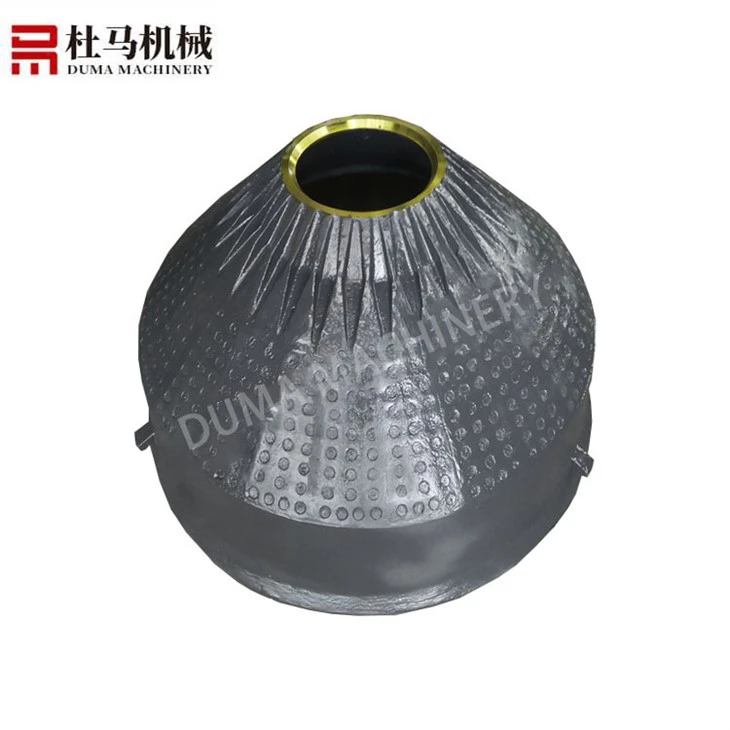
DUMA Titanium carbide (TiC) insert bowl liner and Concave for cone crusher wear parts
Selecting the Right Grade: A Practical Decision Framework
Use this as your starting checklist before every liner procurement decision:
| Crushing Stage | Rock Type | Abrasion Condition | Recommended Grade |
|---|---|---|---|
| Primary (soft rock) | Limestone, marl | Low | Mn13Cr2 or Mn18Cr2 |
| Secondary (mixed quarry) | Granite, dolomite | Medium | Mn18Cr2 |
| Secondary/tertiary (hard rock mine) | Iron ore, copper ore | High | Mn22Cr2 |
| Primary (thick liner, high impact) | Granite, basalt, hard ore | High + Impact | Mn22Cr2+Mo |
| Tertiary/pebble (extreme abrasion) | Quartzite, siliceous ore | Very High | TiC Insert Bowl Liner |
Two additional factors that override the table above: if your current liner is cracking rather than wearing through, always step up to a Mo-alloyed grade regardless of rock type. If your liner is wearing but product shape or gradation is degrading before the liner mass is consumed, the issue is typically liner profile selection rather than alloy grade.
Five Operational Practices That Determine Whether Your Liner Reaches Its Potential
Getting the alloy right is necessary but not sufficient. These five practices determine whether you extract full value from whichever grade you select:
1. Always choke-feed the cone crusher. A partially filled chamber causes uneven wear, prevents proper work-hardening, and reduces throughput. The chamber should remain full at all times during operation.
2. Scalp fines before the crusher. Material smaller than the closed-side setting (CSS) cannot be crushed - it only grinds against the liner surface. A vibrating grizzly feeder upstream eliminates this unnecessary abrasion.
3. Run a wider CSS during break-in. For the first 24–48 hours after a liner change, operate at a slightly larger CSS than your target setting. This allows the manganese surface to work-harden before being subjected to maximum stress.
4. Check torque at 48 hours. Liner settling after installation is normal. Re-torquing the locking hardware at 48 hours prevents loose-liner damage, which can destroy a correctly specified liner in hours.
5. Track cost per ton, not hours per liner. A liner that processes 3 million tons in 300 hours delivers better value than one that lasts 600 hours on 1.5 million tons. Cost per ton is the correct KPI for liner procurement decisions.
Conclusion: Three Actions to Take Before Your Next Liner Order
Audit your current failure mode. Is the liner cracking before it wears through? Or wearing through too fast? Cracking points to alloy grade or heat treatment quality. Rapid wear points to a grade that is too soft for your abrasion index.
Specify by BWI and abrasion index, not by habit. If you do not have your rock's Bond Work Index and abrasion index on file, request it from your laboratory. These two numbers determine your alloy specification more reliably than crusher model or years of experience with a given grade.
Match the grade to the crushing stage, not just the rock. Primary and tertiary crushing impose fundamentally different wear mechanisms. The same ore can require Mn22Cr2+Mo at the primary stage and a TiC insert liner at the tertiary stage.
Duma Machinery manufactures the full range of high-manganese concave and bowl liners - Mn13Cr2, Mn18Cr2, Mn22Cr2, Mn22Cr2+Mo, and TiC insert grades - across a library of 4,000+ patterns covering Metso HP/GP series, Sandvik CH/CS series, Symons, Telsmith, Kleemann, and others. Every batch is metallographically inspected to confirm a clean austenitic microstructure free of network carbides before leaving the facility, and full technical documentation - material certificate, heat treatment curve, hardness test results, and dimensional report - ships with every order.
For a grade recommendation matched to your specific ore and crusher, contact the Duma technical team with your rock type, crushing stage, current liner life, and crusher model. Turnaround on a specification recommendation is typically within 24 hours.
Frequently Asked Questions
Q: Can I use the same bowl liner grade for both primary and secondary crushing?
Not as a best practice. Primary crushing combines large feed sizes and high impact energy - conditions that favour Mn22Cr2+Mo or heavy-duty Mn18Cr2. Secondary and tertiary crushing shifts the dominant mechanism toward abrasive sliding contact, which benefits more from Mn22Cr2 or TiC insert liners. Running a primary-specification liner in a tertiary circuit often results in a liner that never fully work-hardens; running a tertiary-specification liner in primary crushing increases cracking risk.
Q: My liners are wearing unevenly - faster on one side. Is this an alloy problem?
Almost certainly not. Asymmetric wear is the clearest indicator of uneven feed distribution into the crushing chamber. Check that your feed conveyor is discharging centrally, that no chute or rock box is directing material preferentially to one side, and that the chamber is operating choke-fed rather than partially filled. Correcting feed distribution is more effective than changing alloy grade for this specific failure mode.
Q: How do I know when to upgrade from Mn18Cr2 to Mn22Cr2?
The threshold signal is liner life consistently below 500 hours in a secondary or tertiary hard rock circuit, combined with a rock abrasion index above approximately 1,200 g/t. If you have confirmed your feed distribution is correct and your CSS is properly set, and liners are still underperforming, upgrading to Mn22Cr2 is the appropriate next step.
Q: Are TiC insert liners worth the higher upfront cost for my operation?
The answer depends on your throughput rate and downtime cost. In high-volume hard rock mines - particularly remote operations where logistics make every liner change expensive - TiC insert liners typically reach breakeven against Mn22Cr2 within one to two liner campaigns. Request a cost-per-ton comparison from your supplier using your actual tonnage rate and liner change labour cost before deciding.
Q: What should I do if my liner cracks before it wears through?
Cracking before wear-through is a metallurgical signal, not a grade problem alone. Two causes are common: the casting core did not fully austenitize during heat treatment (requiring either a Mo-alloyed grade or a supplier with more reliable heat treatment process control), or the liner is running below its minimum specified CSS, which transfers load to the frame and creates bending stress the liner was not designed to absorb. Eliminate the CSS issue first, then evaluate whether a Mn22Cr2+Mo specification is warranted.


