


Running granite at 1,000 TPH puts continuous pressure on every component in a crushing circuit. When production runs for several months, the cost of worn mantles and concaves is not limited to the replacement parts themselves. Unexpected liner changes can also mean lost production, additional labor, and unplanned downtime.
For high-capacity granite operations, Cone Crusher Wear Parts should therefore be selected as part of a seasonal wear strategy-not simply replaced when the current set reaches its minimum thickness.
The right approach is to match the wear parts to the granite characteristics, crusher duty, operating conditions, and expected production volume, then prepare enough replacement capacity to keep the plant running through the full season.
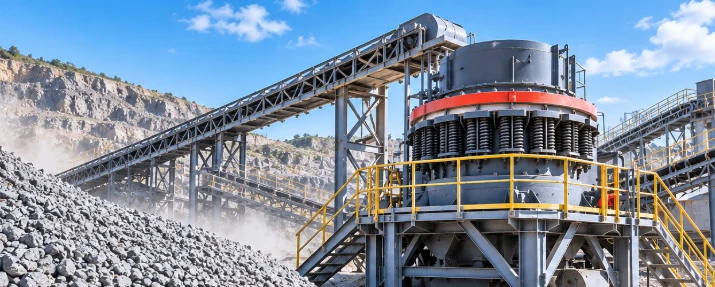
Why 1,000 TPH Granite Requires a Different Wear Strategy
Granite is a hard and abrasive rock. At a production rate of 1,000 TPH, the crusher processes a large amount of material every hour, making liner wear a major operating factor.
A simplified production calculation shows the scale:
- 1,000 tons/hour
- 8 hours/day = 8,000 tons/day
- 25 operating days/month = 200,000 tons/month
Even relatively small differences in liner life can therefore have a significant effect on annual maintenance costs.
For example, if one liner set lasts 250,000 tons while another lasts 350,000 tons under comparable conditions, the difference represents approximately 100,000 tons of additional production per set.
This is why high-volume granite producers should evaluate wear parts based on cost per ton and expected service life, rather than purchasing based only on the initial price.
1. Start With the Granite, Not the Crusher Part
The same cone crusher can require different wear-part configurations depending on the material being processed.
Before selecting a mantle and concave, evaluate the actual granite feed:
Key material factors
Hardness
Harder granite generally increases the mechanical and abrasive load placed on the crushing chamber.
Abrasiveness
Mineral composition and silica content can strongly influence liner wear. Two granite sources may therefore produce noticeably different wear rates.
Feed size
Large feed particles can increase impact loading, while a more controlled feed can produce a different wear pattern.
Moisture and fines
Excessive fines or wet feed can affect material flow through the chamber and change how the liner surfaces wear.
Particle shape
The characteristics of blasted or pre-screened granite can influence chamber loading and product distribution.
A wear-part supplier should ideally understand these operating conditions before recommending a standard mantle and concave combination.
2. Match the Mantle and Concave to the Crushing Stage
For a high-capacity granite circuit, the same liner design is not necessarily suitable for every crushing stage.
The mantle and concave work together to form the crushing chamber. Their profiles determine how material enters, compresses, and exits the crusher.
A suitable chamber profile should consider:
- Feed opening and maximum feed size
- Required product size
- Closed-side setting (CSS)
- Crusher model
- Expected throughput
- Feed gradation
- Recirculating load
- Wear characteristics of the granite
For example, a liner configuration designed to maximize coarse reduction may not provide the same performance when the target is a finer aggregate product.
The goal is not simply to install the hardest liner available. It is to select a liner profile that provides a practical balance between throughput, product shape, crushing efficiency, and wear life.
3. Material Selection: Manganese Is Not the Only Consideration
Many cone crusher wear parts for hard-rock applications are manufactured from manganese steel because of its ability to work-harden under crushing loads.
Common considerations include:
- Manganese grade
- Casting quality
- Heat treatment
- Hardness and toughness
- Wear resistance
- Crusher application
- Expected impact loading
For granite applications, the correct alloy should be selected according to the crusher's operating conditions rather than treated as a universal solution.
A wear part that performs well in one granite quarry may not provide the same service life in another operation.
The supplier should therefore be able to explain why a particular material grade is recommended for the application.
4. Look at Wear Pattern, Not Just Wear Thickness
One of the most useful ways to improve liner selection is to examine how the previous set actually wore.
After removing a worn mantle and concave, inspect whether the wear was:
- Even across the crushing chamber
- Concentrated near the feed opening
- Heavier in the upper or lower section
- Localized around particular areas
- Associated with abnormal crushing conditions
Uneven wear can indicate problems beyond the liner material itself.
Possible causes include:
- Incorrect CSS
- Poor feed distribution
- Segregated feed
- Excessive fines
- Overfeeding
- Incorrect chamber configuration
- Operating outside the crusher's recommended range
Replacing the liner without addressing the underlying wear pattern can result in another short service cycle.
5. Plan Cone Crusher Wear Parts for the Full Season
A high-capacity granite plant should not wait until the current liner set is completely worn before ordering replacements.
Instead, build a seasonal wear-parts plan around expected production.
A basic planning model can be:
Expected seasonal production ÷ Expected tons per liner set = Required liner sets
For example, if a quarry expects to produce:
1,500,000 tons per season
and historical data shows that one liner set produces approximately:
300,000 tons
the operation would require approximately:
5 liner sets per season
In practice, the purchasing plan should also account for a contingency set or additional wear components if the production schedule cannot tolerate unexpected downtime.
The actual number should always be based on historical wear data from the specific crusher and material.


6. Keep a Wear-Part Performance Record
For operations running thousands of tons per day, recording liner performance can turn wear-part purchasing from a reactive task into a measurable maintenance strategy.
For every liner set, record:
| Data to Track | Why It Matters |
|---|---|
| Crusher model | Ensures correct part compatibility |
| Mantle part number | Tracks configuration |
| Concave part number | Tracks chamber design |
| Material/alloy | Compares wear performance |
| Installation date | Measures service duration |
| Removal date | Measures liner life |
| Tons processed | Calculates wear cost per ton |
| CSS range | Links operating conditions to wear |
| Feed characteristics | Explains changes in wear |
| Wear pattern | Identifies abnormal conditions |
| Production performance | Evaluates throughput |
The most useful number is often not simply how many days the liner lasted, but how many tons it processed before replacement.
7. Compare Wear Parts by Cost per Ton
A lower-priced liner is not necessarily the lower-cost option.
Consider two hypothetical liner sets:
Option A
- Purchase price: $8,000
- Production life: 200,000 tons
- Wear-part cost: $0.040/ton
Option B
- Purchase price: $9,500
- Production life: 300,000 tons
- Wear-part cost: approximately $0.032/ton
Although Option B has a higher purchase price, its calculated wear-part cost per ton is lower.
At 1,000 TPH, the difference becomes much more significant because the plant processes large volumes of material.
This is why procurement teams should compare:
Part price + expected service life + downtime risk + installation cost
rather than comparing the purchase price alone.
8. Keep Critical Wear Parts in Stock Before Peak Production
For a 1,000 TPH granite operation, a missing liner can become a production problem very quickly.
A practical seasonal inventory may include:
- Complete mantle
- Complete concave set
- Required fastening components
- Backing material where applicable
- Other crusher-specific wear components
- Emergency replacement parts
The exact inventory level depends on supplier lead time, shipping conditions, liner life, and the consequences of downtime.
For imported wear parts, lead time should be considered especially carefully. A replacement that takes several weeks to arrive may be unacceptable when the crusher is the bottleneck of the entire production line.
9. Work With a Supplier That Can Support More Than One Shipment
For large granite operations, the supplier's role should extend beyond sending replacement parts.
A reliable Cone Crusher Wear Parts supplier should be able to provide:
Crusher compatibility
Parts should be manufactured according to the exact crusher model and required configuration.
Material recommendations
The supplier should understand the difference between general-purpose wear parts and parts intended for highly abrasive hard-rock applications.
Production consistency
Each batch should maintain consistent dimensions, material quality, and casting performance.
Spare-parts planning
The supplier should help estimate seasonal requirements based on expected production and historical liner life.
Technical communication
When wear patterns change, the supplier should be able to review operating conditions and recommend adjustments rather than simply supplying another identical set.
10. Build a Seasonal Replacement Strategy Before the First Ton
For a 1,000 TPH granite plant, a full-season wear strategy can be organized into four stages:
Before the season
Review:
- Previous liner life
- Production targets
- Granite characteristics
- Crusher operating parameters
- Previous wear patterns
- Supplier lead times
Then calculate the expected number of liner sets.
During the season
Track:
- Tons processed
- Liner condition
- CSS
- Feed distribution
- Production rate
- Abnormal wear
Do not wait until the liner is visibly damaged to start planning the next replacement.
Before each replacement
Check whether the wear pattern matches expectations.
If wear is significantly different from the previous set, investigate the operating conditions before ordering the same configuration again.
After the season
Calculate:
Total tons produced ÷ Number of liner sets used
This provides a practical baseline for the next purchasing cycle.
A Practical Checklist for 1,000 TPH Granite Operations
Before ordering Cone Crusher Wear Parts, confirm the following:
Exact cone crusher model
Mantle and concave configuration
Granite hardness and abrasiveness
Maximum feed size
Typical feed gradation
Target product size
Operating CSS
Historical liner life
Tons processed per liner set
Previous wear pattern
Required seasonal production
Expected number of liner sets
Supplier lead time
Emergency spare requirements
The more complete this information is, the easier it becomes to select a wear-part configuration based on actual operating conditions rather than assumptions.
Final Takeaway
At 1,000 TPH, granite crushing is a high-volume operation where small improvements in liner life can translate into significant production and maintenance savings.
The best Cone Crusher Wear Parts are not simply the parts with the highest hardness or lowest purchase price. They are the parts that match the crusher, granite characteristics, chamber configuration, operating parameters, and production target-and deliver predictable wear throughout the season.
For quarry operators, the objective should be simple:
Select the right liner configuration, measure its performance in tons, and plan replacement capacity before the next set is needed.
That approach turns wear-part purchasing from an emergency maintenance decision into a predictable part of the crushing operation.
Looking for Custom Cone Crusher Spare Parts?
Please contact us with your crusher model, part name, and number, and we will strive to fulfill your order.


