


Introduction: The Question Every Maintenance Manager Eventually Asks
Here is a scenario that plays out in mining operations around the world: the lower mantle on a primary gyratory crusher shows 80% wear after three months of service, while the upper section looks nearly untouched. The plant manager orders a full mantle replacement anyway - because that's what the schedule says - and thousands of dollars of usable material goes to waste.
This happens because most operators treat the mantle as a single, uniform component, when in reality the upper and lower sections perform fundamentally different mechanical jobs, wear at different rates for specific physical reasons, and ideally should be managed independently. Understanding how these two zones work together is not just an academic exercise. It directly affects liner replacement strategy, material costs, and crusher uptime.
This article breaks down the mechanics zone by zone - following the ore as it moves through the crushing chamber - and explains what that means for the people responsible for keeping the machine running.
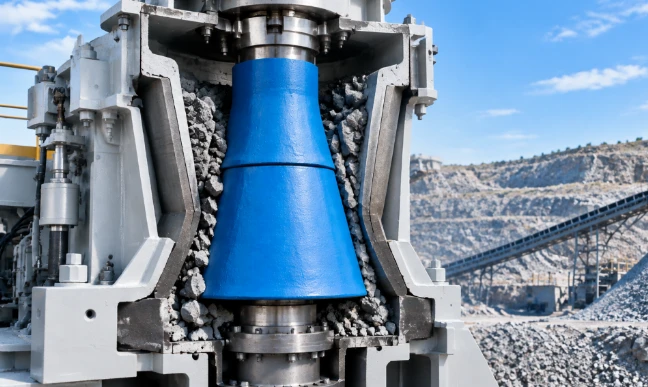
Gyratory crusher showing upper and lower mantle sections
1. The Basic Architecture: One Component, Two Jobs
A gyratory crusher's mantle is a truncated cone of manganese steel fitted over the mainshaft. As the eccentric bushing rotates at the base, the lower end of the shaft traces an elliptical orbit around the crusher's centerline. This gyrating motion causes the gap between the mantle and the fixed concave liners - the stationary ring lining the crusher's outer frame - to open and close continuously, squeezing and fracturing rock in between.
The critical detail most operating guides gloss over: the pivot point sits at the spider cap at the very top of the crusher. This means the mantle does not swing uniformly. At the upper end, the lateral movement is almost negligible - a few millimeters of throw at most. As you move down toward the discharge, that throw increases progressively, reaching its maximum at the base. Crushing force is a direct function of throw. The lower zone, therefore, does the heavy lifting: it is where particle size reduction is finalized, where the gap is tightest, and where the mechanical stresses are greatest.
In engineering terms, this is why the lower mantle is where the real work happens - and why historical operating data consistently shows that approximately 90 to 95% of total mantle wear is concentrated in the bottom half of the liner.
2. The Upper Zone: Receiving, Slowing, and Pre-Fracturing
When ore enters through the feed opening at the top of the crusher, it first contacts the upper section of the mantle. At this stage, feed material is at its largest - sometimes boulders exceeding one meter in diameter in primary crushing applications. The gap here is wide, the throw is small, and the crushing action is relatively gentle.
The upper zone's primary roles are:
- Receiving and distributing the feed evenly around the crushing chamber to prevent concentrated loading on one side
- Applying initial impact fracture - large rocks begin to break on first contact, reducing to sizes that can progress downward
- Slowing and guiding material by the converging geometry of the chamber, ensuring a controlled, choke-fed flow
Because the forces in this zone are lower and the contact is less abrasive (the ore has not yet been reduced to fine, sharp particles), the upper mantle wears relatively slowly. A single-piece manganese liner in the upper section often retains serviceable geometry long after the lower section has reached its wear limit.
This is precisely why leading manufacturers and experienced maintenance teams now favour a two-piece mantle design - separate upper and lower liner sections that can be replaced independently. As documented in multiple patent records dating back to the early 20th century, the rationale has always been straightforward: replacing both sections simultaneously when only one is worn wastes expensive manganese steel.
3. The Lower Zone: Where the Crushing Actually Happens
By the time ore reaches the lower section of the mantle, it has already been reduced in size and is now subject to a very different mechanical environment. The gap is at its minimum (the open-side setting, or OSS, which defines final product size). The eccentric throw is at its maximum. The rock being crushed is now finer, more angular, and significantly more abrasive.
This zone operates under laminated crushing - multiple particles are compressed simultaneously between the mantle and concave surfaces, which is far more efficient than single-particle impact but exponentially more demanding on the liner surface. The compressive stresses in this region can be two to three times higher than those in the upper zone during peak loading.
The consequences for wear management are significant:
The lower mantle surface work-hardens rapidly under impact. High-manganese steel (Mn13, Mn18, or Mn22) is specifically chosen because its austenitic structure allows the surface hardness to climb from an initial ~HB200 to over HB500 in service - but only if the heat treatment has been correctly executed to produce a pure austenite matrix free of brittle carbide precipitates.
Wear is not uniform across the lower section either. The zone of greatest wear typically concentrates between roughly 60% and 85% of the mantle height - the area where particle size reduction is at its most intensive.
Product output size, throughput capacity, and power draw are all directly controlled by the lower mantle profile. As this section wears, the effective OSS increases, product becomes coarser, and the operator must adjust the mainshaft height to compensate.
Sourcing a high-quality gyratory crusher upper mantle or lower section from a supplier with rigorous metallographic quality controls is therefore not simply a procurement decision - it is an operational one. A liner with residual carbide in the microstructure may look identical to a correctly processed one, but will fracture rather than work-harden under load, potentially leading to catastrophic liner failure and unplanned shutdown.

DUMA Gyratory Crusher Upper Mantle
4. How the Two Zones Work Together: The System View
The upper and lower sections of the mantle function as an integrated system with a clear division of labour:
| Function | Upper Mantle | Lower Mantle |
|---|---|---|
| Primary role | Feed reception, initial fracture | Final size reduction |
| Eccentric throw | Minimal | Maximum |
| Crushing force | Low–moderate | High |
| Wear rate | Slow | Fast (≈90% of total wear) |
| Material criticality | Standard Mn steel | Higher Mn grade preferred |
| Replacement frequency | Low | High |
The two zones must be geometrically compatible at their interface - whether locked by keys, helical surfaces, or modern mechanical interlocking systems - to ensure that the mantle profile presents a continuous, smooth crushing surface to the concave. Any mismatch at the joint creates a stress concentration point and a local change in the nip angle (the angle at which rock is gripped and pulled into the chamber), which can cause material slippage or accelerated localized wear.
When selecting mining gyratory crusher wear parts, operators should confirm that the supplier's upper and lower liner sections are designed and cast as matched sets for their specific crusher model - not generic profiles adapted from adjacent models.
5. Practical Wear Management: What This Means for Operations
Understanding the upper/lower division leads directly to better maintenance decisions:
- Monitor the lower zone independently. Rather than replacing both sections on a fixed calendar schedule, install a wear monitoring system - whether laser-based gap measurement, periodic manual gauging, or predictive tracking by operating hours - focused specifically on the lower mantle. When lower wear reaches the critical threshold (typically 80% of original profile depth), plan a lower section replacement. Inspect the upper section at the same time and replace it only if wear justifies it.
- Match material specification to zone. The lower mantle, subject to the harshest conditions, benefits most from higher manganese grades (Mn18 or Mn22) or advanced alloy compositions. The upper section, under lighter loads, can often run a standard Mn13 grade without compromising life. A supplier able to cast different sections from different alloy specifications provides a significant cost advantage.
- Ensure choke feeding. The lower mantle wears most evenly - and achieves maximum work-hardening - when the crusher runs choke-fed (chamber consistently full to the spider cap). Trickle feeding creates impact events rather than laminated crushing, concentrates wear in specific areas, and prevents the manganese steel from developing its full hardness potential.
- Track OSS drift. As the lower mantle wears, the open-side setting increases. Regularly compensating by raising the mainshaft extends liner life but eventually reaches the adjustment limit. Trending this adjustment need against operating hours provides an early indicator of approaching replacement.
Conclusion: Actionable Steps
The upper and lower mantles are not interchangeable or equivalent - they are two specialized components serving complementary functions within a single system. Acting on this understanding:
- Audit your current replacement schedule. If you replace both sections simultaneously by default, calculate the residual life of the upper section at each changeout. The cost of discarded usable liner adds up quickly across a fleet of crushers.
- Verify your liner supplier's metallurgical controls. Request metallographic test reports showing austenite purity (zero carbide precipitation) and hardness curves. A supplier with in-house metallographic testing capability, controlled water quenching heat treatment, and full batch traceability - issuing material reports, dimensional reports, and heat treatment curves for each production batch - provides a meaningfully lower risk profile than one that cannot demonstrate these controls.
- Invest in lower-zone monitoring. Precision in knowing when the lower mantle reaches its wear limit, rather than guessing, is the single highest-return maintenance improvement available for most primary crushing circuits.
FAQ
Q1: Why does the lower mantle wear so much faster than the upper section?
The physics are straightforward: the eccentric pivot is at the top of the crusher, so lateral movement - and therefore crushing force - increases progressively from top to bottom. The lower zone operates at maximum throw, minimum gap, and against the finest, most abrasive particle sizes. Studies and historical operational data consistently place 90–95% of total mantle wear in the lower half of the liner.
Q2: Can I run a gyratory crusher with mismatched upper and lower mantle sections from different suppliers?
Technically possible in some cases, but inadvisable. The interface geometry between upper and lower sections must be precisely matched to ensure a continuous crushing profile and correct load transfer at the joint. Using unmatched sections risks stress concentrations at the junction, local nip angle distortion, and premature cracking. Always use sections designed and tested as matched pairs for your specific crusher model.
Q3: What manganese grade should I specify for the lower mantle versus the upper?
For heavy-duty primary crushing of hard, abrasive ore (iron ore, granite, copper ore), the lower mantle benefits significantly from Mn18 or Mn22 grades, which provide a deeper work-hardening reserve. The upper mantle, under lighter loading, typically performs adequately in Mn13. For soft, non-abrasive materials, chilled cast iron may be more economical in both zones. The right answer depends on your specific ore properties and crushing intensity - a qualified supplier's technical team should provide a recommendation based on your operating data.
Q4: How do I know when to replace the lower mantle without stopping the crusher for inspection?
The most practical indicators are: (a) OSS drift - if you are consistently adjusting the mainshaft upward to maintain product size, liner wear is advancing; (b) power draw increase without a corresponding feed rate change; (c) product grading coarsening beyond specification; and (d) if your operation has installed laser gap measurement or vibration monitoring, those systems provide continuous wear data without shutdown. Track these parameters against a baseline established with a new liner set.
Q5: Is a two-piece mantle design always better than a one-piece for primary gyratory crushers?
For large primary gyratory crushers, a two-piece design is standard practice and recommended. The weight of a one-piece mantle for a crusher in the 1,500mm+ size range makes installation impractical, and the inability to replace only the worn lower section makes it economically wasteful. For smaller secondary gyratory applications, one-piece mantles are still used where the weight is manageable and wear differentials between upper and lower zones are less extreme.


